Category Archives: Uncategorized

View from My Nipa Hut

I wrote the following one day, in the autumn of 1975, some time after I moved into my nipa house and settled into my life in the barrio.

Even now I relish Saturday mornings, the very idea of awakening to a day to be felt beneath the skin. Once upon a time I liked sleeping-in on such mornings, but I prefer now to wake at sunrise to long peaceful hours spent in morning solitude. Throwing a smock (which lays always tossed at the foot of the bed) over the long night’s dream-spent nakedness, I carry the lantern back to its hook in the main room, then unwire the bamboo hatch door and descend, as if in a sea-going vessel, to the toilet below the house on stilts. Reentering the upper deck the day begins as the mosquito net is taken up and the windows are untied and pushed back, letting in an orangeness to fall in patterns designed by filtering palm trees. Admittedly the cocks have long been crowing and the majority of neighbors rose by 4 a.m. (one or two hours before dawn); yet I feel the gratitude of waking “early” with an alertness never known since childhood. I used to drag my bones wearily from the mattress and flounder all the daylight hours (except when too madly busy) wishing to chance upon a pillow and stolen moments (stolen from who? I never figured). Here there always remains the option of an afternoon siesta during that peaceful time of day when all activity magically ceases—magic to an American-grown. But just now siesta is hours away; the early morning sun is still weaving through the swaying palms to its dance across the bamboo floor and woven partition of the bedroom, which is situated in the southwest corner, away from the rising sun. I enter the bedroom but notice later with some melancholy that when the blankets have been folded, hair brushed, shorts and tee-shirt replaced the smock, and the bed-table is being carried to the main room to resume its role as desk, eating table and end-table, the sun streaks beyond the partition have stilled and dimmed from orange to paler yellow. The sun, above the trees now, will soon turn the day into its white, work-a-day world. Nonetheless, having glimpsed these early oranges catches in my memory, making easier the acceptance of an onrushing brightness. In another life I woke late to a world already washed in white, blinding, and like an electric shock, tensing the nervous system in preparation for a rat-race existence.

Sad to see the early edgeless colors slipping into daytime clarity, but happier to have caught the soft serenity—in this frame of mind I set about my business, meager as it may be. My mind wanders of its own accord as my feet carry my body and two buckets along the muddy path to the water pump. Daily with greater proficiency I carry these two brimming buckets up the stairs into the house, kicking off my sandals upon entering. I also make a game of alternating pumping arms, so as not to develop nonsymmetrical biceps. One bucket now lends itself to washing yesterday’s clothes—having soaked first overnight—and the dishes accumulated after the evening meal, perhaps a cup and spoon from tea or hot chocolate. The other bucket stands faithfully by for the day’s demands. After hanging the wet clothes and preparing something hot to drink (regardless of health advice, I still hate hearty breakfasts)—simply enough, my manual labor is completed. I ought to feel guilty that the townspeople “pity” me this very labor, which is carried out with a minimum of effort, and my life alone, which I find delicious, with no “helpers”. I smile at the irony, a smile generally mistaken for embarrassed humility, as I honestly wonder what busies people so. For me to have a household “helper” as is frequently suggested (and household help is sinfully cheap here) would be undesirable and perhaps unpardonable—to so lack initiative to forego the smallest amount of labor necessary, in my opinion, to maintaining a free healthy body, not to mention a self-respect. What debt would I unwillingly owe society if I willingly depended upon it for my basest needs? There is no denying however, that as a foreigner in the most accommodating of cultures, a trap of laziness and dependency is an easy one in which to fall. For nine months I lived with a local family, fearing to alienate myself irreparably by breaking social patterns, a generous family who forbade me so much as to clear my supper dishes from their table. I was always a China doll, to be handled with indulgent care. When weather, or my own lack of initiative did not permit long afternoon walks and/or swimming, my unspent energy would burst inward causing me to lapse into spells of frustration, loneliness, sluggishness, and short-temper directed self-inward—frequently even becoming physically ill from my under-exertion and overeating, both fundamentals of the culture. Looking back, I was fortunate to have had available the periodic saving outlet of tears, to dilute my frustration. This measure proved numerous successes though it was not an option to my neighboring volunteers down the coast, being all males and therefore limited by their thwarted upbringing. I must add, however, that males, on the whole, have many more advantages—the opportunity of physical activity such as basketball, the chance to relax during evening get-togethers and drinking sessions with local contemporaries. A female, on the other hand, is generally protected and confined to the home of her “host-family” from dusk until dawn. How I longed to see the moon and the stars those first few months. Even during daylight hours, females are severely discouraged from wandering without a “companion”. With the poor lighting, as there is no electricity in this rural town, evening restrictions begin early, confining one to quarters and leading to over-extended sleeping hours, further laziness and concurrent sluggishness. Here in my own nipa house, although I’m still “confined to quarters” after dark by local mores, I enjoy the priveleges of minor daily activities to maintain the premises and of waking slowly and silently through my morning chores. I drown my lethargy in vigorous water-pumping or floor-polishing (a local ritual dance, as I call it, of sliding barefoot on a half-coconut husk over the bamboo slats. The entire body weight is balanced on one foot sliding across the floor atop an inverted half coconut. The other foot maintains the balance and rhythm as it hops across the floor directing the activity. The process seems to be as efficient as expensive, electric, department-store buffers. It further seems to be marvelous exercise for the knees and fore-thighs.) At dusk I usher out the day in a similar fashion, slipping easily into the peaceful evening as I go about my mindless tasks—fetching water for the toilet, dishes, and “bath”, sweeping, dusting (what little there is to be dusted), floor polishing, walking a few blocks for drinking water once or twice a week, perhaps a short trek to the market for kerosene or fish or vegetables, filling and pumping the lantern and stove, burning garbage weekly, doing a few ritual exercises for peace of body and mind (possibly omitted depending upon the current status of my self-discipline), lighting the lantern, and lastly, when once again all color has left the blackening sky, I pull back the windows and tie them shut. Aside from cooking, these daily chores take less than one hour if carried out efficiently. I find this small amount of work healthy, an opinion substantiated by my previously unhealthy state during a parasitic existence with a kind, but over-accommodating family.

Nonetheless, if ever a life was undemanding, this one is. The only demands are self-imposed, rather than societal. Even my so-called “job” melts into the pattern, leaving me free to function in my assigned capacity, or not, as personal initiative, opportunity, or guilty conscience dictate. This is the life people dream of during the mad hours of their busiest season–a life unbound by time with chance enough to notice the colors of the day; the rare life, like at Walden Pond, when a human being unlimited can experiment with life-style as it relates to eventual peace or happiness or whatever goal, if indeed, a goal be desired. Here is living with no place for excuses or rationalization—an opportunity thay potentially exists everywhere, but in reality, perhaps is rare. Just now, I desire to attempt each new day in this light—as if each were magically the beginning of a rare and significant experiment in growth, in living. Sluggishness, boredom, and complacency, may very well be the signs of failure, my enemies. But just now as one day is still fairly beginning, my vaguest responsibilities behind me, I face the question of the day—How shall I live this free and unlimited day?

As usual, I postpone any decision for purposeful activity, preferring just now to read by the window in the morning’s lingering coolness as passersby seem too preoccupied to stare beyond my bamboo boundaries. I, the stranger living alone against custom, a strange curiosity with blue eyes and white skin, seem perpetually to be ‘on exhibit’ and so now grasp at the opportunity to reverse the habitual roles, becoming the unnoticed observer, an audience of one before this stage of local activity. Pretending to read, it’s the Saturday sounds that urge me to halt between paragraphs and identify the distant reverberating noises. The church is sounding three bells—one very low and familiar (used as the local time-piece, a rural “factory-whistle”, announcing dawn, noon, and dusk with six, twelve, or six clangs respectively); the next clang is somewhat higher though more penetrating like a school-bell calling children from recess; and the third clang is tinny and awkward, as if for lack of anything better, an old woman is calling her deafening husband in from the fields, making use of a collection of large pots and pans. These three bells sound in succession, though lacking a definite beat, for several minutes. As the intervals of silence lengthen (I suppose the toller is tiring) there can be distinguished another deeper, rhythmical, thundering sound. Shortly, when the bells have ceased altogether, a whole cacophony is heard accompanying what is obvious now to be a large drum. No doubt it’s the local, bare-footed street band gathered with their rusty ancient instruments to march (for a fee) with one of the endless successions of funeral processions. The town assuredly has committed to memory the band’s small repertoire of tunes—dreary hymns, cheerful marches, and outdated popular love songs. These noisey rainbow parades of umbrellas crowd the streets in disorganized fashion to the same accompaniment, year-in, year-out, so unbelievably frequent in every barrio of the province; it seems the municipalities must be importing their dead in order to keep strong the businesses of funarias, marching bands, and umbrella sales. The funerias “rent” rather than sell the plastic flowers and silver spray-painted caskets. The passing processions fade in the distance, seemingly unnoticed as life continues—no thought given to the passing of life or the barefoot trumpeters. Like the townspeople, I begin to accept this delicate, fluctuating balance between life and death as routine….”So Mrs. Dela Cruz’ little boy died of tetanus (was that the boy in third or fourth grade.)”, and “Mrs. Vista had a baby at midnight. Was that her twelfth?”, and “Dodong’s motorcycle isn’t working well.”. I hear the squeaking water-pump and children tossing pebbles, a woman is selling fish and a hoarse dog is barking at a passing bicycle.

Hours pass in just this manner; reading chapters all in all but especially absorbing the day—the sights, the sounds, the routines. All this quiet observation maintains the interest of my wandering mind until the increasing heat begins to overtake me, threatening the dreaded tropical drowsiness lest I take up another plan of action. Realizing the hazard before me, I rise and rattle around the house like a dog shaking off a summer’s nap.

The day passed, like a hundred others, resting beyond the touch of memory. Perhaps I was caught in conversation or went to the beach for an afternoon swim, finished a novel I was reading, or caught a jeep ride to a nearby town to visit an expat and drown in conversation and hidden habits of a culture whose framework was lost to us now. I might have made a particularly good soup for dinner that night, or Quaker Quick Oats.

The sun rises, passes, and sets. I interact, perhaps less passionately than in my first months. I’ve even lost the clever cynicism capable of authoring  witty letters I sent during the frustrating and often depressing days of my adjustment phase. I passed then through a melancholy time of passionate reverie for the Cascade Mountains, temperate seasons, and other symbols of “home”. The hatred died, nostalgia lessened, the cynicism came to be in jest, my depression dissipated, and I came to the limbo in which I float these recent months. It strikes me that this strange development is my reason for writing this journal of thought and feeling. Perhaps this is an inquiry, a probing into an unnamed sense of spirit that might be mistaken for ennui or boredom or complacency. The question arises, “why am I not bored?” That’s it. I want my pen to probe this for me before I lose the remnants of being simply unbored. Happy is an insufficient word. It is not what I mean to imply. Lola, the grandmother here, might merely say that I am satisfied and it is enough.  There’s a trap or gate that lies at the a narrow border between boredom and acceptance, between nothingness and simplicity, between dissatisfaction and peacefulness. It’s all around me here. It sends volunteers home early, bored and cynical; it brings others a fulfillment and acceptance. Perhaps I am experiencing the latter.

 

Amoeba, French Toast, and a Nipa House; August 1975

Nasty Parasites

Turns out I’ve had chronic amoebic dysentery for months. I was treated and became joyous about the prospect of getting my strength back. But improvement was slow and treatment side effects set me back. At times I felt like crying. I still felt horrible and was freaked out about bloody urine. My mood was saved by enjoying good conversation of other volunteers. When I finally saw Dr. Gozo, he said the bloody urine and nausea are side effects of the medicine. He told me to go on my planned vacation. So I left for Mindanao, though I was not feeling well at all. While vacation was fun, I remained sick. I doubt myself. Am I really always sick? or have I become a pessimist, or hypochondriac? When in town, it seems like I mostly sleep. My health and lack of energy is discouraging. By mid-August, though back at work, my health was poor. I felt hot, lacking in energy, and depressed. I’m wondering if this amoeba may be a permanent thing. On the last day of August I discovered that I’ve got worms—probably tapeworms—that’s what it looks like.


The Great Peace Corps Exodus

I learned that Bob is going home. I can certainly understand. The day before I had spent in barrios Camangahan and Ilaures weighing children with the nurses and Mrs. Nava. I felt hot and listless. I was depressed and had no energy. I took a nap at 3 in the afternoon. I felt close to terminating, wanting to go home and be a hermit. My unhealthiness makes my motivation dwindle. When I woke from the nap I finished reading Rubyfruit Jungle, which I enjoyed, but it depressed me by reminding me of the independence I don’t have here. So I understood Bob’s decision.

For me, pondering an early departure, flying home is the result of a combination of things. I often get a feeling that I’m not useful here and I wonder if I’ll get much more out of the experience. It’s like that feeling you get in the middle of college, “What am I doing here?” and “Should I just move on to the rest of my life?” Perhaps we’re all just impatient in our early 20’s. It’s hard to make a decision and I can’t imagine what else I would do. Chances are I’ll probably stay here and complete my service, just like I did in college. But I want to be sure that my growth here is positive. I don’t want to act out of inertia. So many volunteers are quitting and going home. I think nine of our group have gone home already. That’s nine out of 28. There are only 3 volunteers left in my province. Our group has the highest termination rate in the Philippines and the Philippines Peace Corps has the highest termination rate in the world. Until this year it was the lowest. They’re calling it the domino effect, but at any rate, just about every volunteer talks about the possibility of going home for Christmas.

My mood was saved by enjoying good conversation with volunteers from other groups. It was nice to see some happiness, seriousness, and idealism left. The morale of our own group is depressing to say the least.


Bahay Kubo (My Little Nipa House)

I’ve made a big decision to move. No, not back to America, but from barrio Pojo to barrio Ilaya about ½ kilometer away. I’m going to live alone. The extended family is too overwhelming and noisy for me just now. I want to do my own cooking and housework. Now that I’ve lost all the weight from amoebic dysentery, I need to think about maintaining my health and activity. The doctor in Cebu told me not to eat a lot of the typical foods that are hard to avoid when you’re living with a family. The family mostly eats rice and dried fish and a spinach-like green once a day. Not enough vegetables or fruit for my liking. I’m sure I’ll like living alone. I hope to get a cat.

Tomorrow I find out for sure if I can rent the Condez’ house in Ilaya. It will cost me 30 pesos/month I think (That’s almost $4.00). I will be disappointed if this falls through. The house is huge and open. It’s made of nipa (grass-like) and bamboo and is raised on stilts. The water pump is close and the toilet is water-seal (you flush it by throwing a bucket of water in). The toilet is a lot nicer than the one where I live now; it’s not outside. When you go down some stairs, you end up under the house at the toilet. Pretty nifty. I think I’ll get a 2 burner gas stove, like a Coleman, and maybe a “petromax”, like a Coleman lantern. I’ll need to buy a bed frame, mat, mosquito net, some pots, pan, dishes, and some buckets for showering, doing laundry and dishes, and flushing the toilet. It should be fun setting up house. I might even plant a garden. It’s a big step which will most likely make the two years better for me.

Telling the family that I plan to move was difficult. I told Inday first, then Nene. I think they understood. I explained that they were still my family and that I would come and visit often. But when I told Lolo and Lola, they were very upset and worried for me. I’ll surely have to come back here often to reassure them that my move is not an indication that I don’t care for them.


Travel and a Retreat with Other Volunteers

Cebu City

Being in the big city, even with other volunteers,  life is so different. It was great to be with Patty from my group. We relaxed with a capital R, how fine. I enjoy her company. Just doin’ nothing. Patty and Linda and I toasted our 9 months of poignancy here in the Philippines. When I left Cebo, Patty took me to the airport and hugged me good bye. Feels like we’re sisters!

One day several volunteers hung around the Peace Corps Office having an interview with a State Department character. Then one evening we went to a consulate cocktail party. The PCV’s looked like tramps, but we all enjoyed ourselves and acted natural.

To fade in and out
of another human realm
can have impact immeasurable
independent of speed
and friction variables
less if approached
with safety devices

 War, Fire, and Pestulance – Visiting Volunteers in Mindanao

When I got to Cagayan I spent most of the day with Joe Shwegman in easy, natural conversation. We’re quite alike I think, only masculine and feminine versions. I’m loving being open, honest, and real. We went to a Walt Disney Movie and laughed hard.

I took a trip to visit Steve in Claveria. It took all day, with a swimming stop and a delay for flooding. I was still feeling sick and exhausted when I arrived at midnight. The next day, Steve showed me around and we went up to the mountains on motorcycles with Barry (another volunteer). I think Steve is growing a lot in Claveria, what a beautiful thing to see.

The return trek to Cagayan was miserable. We we met Joe and Rick, overdosed on ice cream, and went to a movie. I’m enjoying being with friends.The next day we headed to Iligan and got a room, did some crossword puzzles, took siesta, went to dinner and saw the movie Crazy Joe—too bloody for my taste. I was really exhausted and had weird dreams that I was sent home for being sick.

The following day we had to cancel our one hour trip to the Muslim city of Marawi because of the war. There had just been an ambush; 60 Muslim women and children were killed on that road by Christian radicals. They say the road is not safe until the Muslim radicals kill about 60 Christians in reprisal. The four of us decided to stay in Iligan. We had a good time, bought batik, native mats, baskets, shell plant hangers. Steve loves to bargain. We ate dinner at a neat restaurant and had fun bowling. Steve and I did terrible together. Joe and Rick are good.

We messed around in town and witnessed a huge two block fire. The buildings are cheap with bamboo houses scattered among the big wood buildings; so it burned rapidly. I swear the people saved everything from the buildings—mattresses flying out windows, everything. I think some people even saved their garbage. The people worked incredibly efficiently without specialized equipment and rescued almost all their belongings. Spectators did not get in the way as they would have in the states. In the afternoon we headed back to Cagayan with some very friendly Mormon Americans.

On the my last day in Mindanao, we shopped more and went to another movie, though I was burned out on movies. Kathy and I caught the Tuesday 7 p.m. boat to Cebu, sleeping in the boiler room, lower 3rd class. The boat didn’t actually leave until 2 a.m. It took 12 hrs.; so we spent 20 hrs. on board. It was nice to see Patty again, and of course the doctor.

The following day I caught an early flight to Iloilo and a bus to Antique. It really is more layed back and slow paced here than in Cebu or Mindanao. I love it. Seeing the rice fields on the mountains is an exquisite welcome back. The family accepted me back as if I’d never gone away. I was afraid it might put distance between me and them. It didn’t.

Now I can see that this time
will some day be gone to flowering
in unapproached mind areas
transformed point of view
forever existent part of who I am

Skinny Dipping, Baptist Visitors, and a Stellar Breakfast

Just now I could stay here forever, at Camp Magsaysay. I would listen to the waterfall, watch the butterflies and lily pads on the pond, listen to folk music tapes, play Frisbee, skinny dip with the other Peace Corps women, read, and be free of staring eyes. I’m at a retreat with only peace corps volunteers, on the island of Bohol. It’s a luxury camping trip with a hired cook and a couple of spring fed swimming pools. The water is cool, but not freezing like in the Cascades. We’re at 2000 feet elevation in the mountains. The first day I got badly sunburned, but on the second day it was only 83° at 3:30 p.m., which felt cool and comfortable to me. I remember sprawling out on the meadow in the sunshine and someone finding a gray hair on my head. Days passed with Frisbee matches, volley ball, swimming, poker games, reading, etc.

The second day we relaxed all morning; having good talks with the women. I miss having American women in my assigned province. Then we went to the Chocolate Hills with John Loftus, Chris Hellwig, and Patty. That’s a scenic place 12 km. from our camp. Geologists still haven’t figured our how they came to be. They look like a bunch of rounded off chocolate chips. We had a good time, nothing dynamic, just mellow scenery, mellow people. In the evening there were poker games and comerarderie.

IMG_0054

Patty and others from the group ahead of us at the chocolate hills in Bohol


The food has been memorable. Last night we had dinuguan (pig intestines cooked in blood) and ampalaya (a vegetable with the texture of rubber bands and a taste more biter than anything I have ever experienced). The main course, however, was liver. The only thing to drink here is beer or coke (no milk or hot chocolate). I can’t even drink the beer any more because it aggravates my amoebic dysentery.  But the crowning touch was breakfast. We had asked for French Toast and we got it. The cooks had toasted all the bread and slathered it with the deep golden yellow French’s Mustard we’d brought for hot dogs. Great breakfast with a side dish of red rice and pork fat!

Its been a bonding experience for the two groups of rural health volunteers. One morning we occupied ourselves making tattoos on each others’ bodies with flair pens. Things like: “Sisterhood is Powerful” with a fist inside a female symbol.  Just when half of us were fully tatooed and the other half were skinny dipping in one of the pools, some Baptist missionaries from Minnesota showed up (we had rented a Baptist camp). The tattooed half kept Mr. and Mrs. Bible away from the pool and sent someone down the hill to ask the swimmers to be silent. Mr. Bible was quite a brilliant man, especially about politics. When I asked what he thought of martial law, he stated: “I think it’s good because now the men come home to their wives” (curfew and all). Isn’t that deep? Maybe Gerald Ford ought to try it in the states?

It’s been great skinny dipping with the other women when we slip down to the pool at night, singing old songs in the pool like Teen Angel, and doing the hokey pokey (you put your left boob in, you put your left boob out, you put your left boob in and you shake it all about, you do the hokey pokey and…) Between reading Rubyfruit Jungle, circumstances, and the fun I’ve been having with women, I feel myself being pulled in opposite directions, but I guess I feel safer with the female group.

To have the chance to walk alone unnoticed
stranger in a strange land having found
this week’s hideaway with naked nights
and freedom strolls for revitalization

Then, during the evening poker game, the blue eyes of one of the guys pulled me in. We began a mutual crush. We had a great time making up stories about how romantic the setting was. One evening we scurried away to one of the empty cabins back in the woods. He lit a candle and we sat down, but the rotting structure collapsed underneath us. He says, “this isn’t how it is in the movies”. I said “sure it is, if we’re Ryan O’Neil and Barbra Streisand as opposed to Ryan and Ali”. His gentleness and patience made me feel better than in as long as I can remember. It was nice to spend uninhibited time without any Filipinos staring or starting rumors.

Holding back from blue eyes calling
past other minds not hearing words
unsaid from you to me in crowds
leading inevitably to hours of skin
unguarded when I’d forgotten how to give

Finding Purpose – July 1975

Mental Illness

I suffer because a stranger suffers
while those who know him
show no compassion
how can a stranger share with me
so much of humanity

Last week people began a new topic of gossip—something to laugh about. “Have you seen the crazy one?” “Oh Iking is mad. Did you see him in barrio X?”  I didn’t appreciate the jokes for the harm they were probably doing to the poor man. Then, after the dance Thursday night, we met him on the road. He asked for a ride and I guess the doctor was afraid to say no. He got in beside me. I didn’t know this was the “crazy one”. In fact, it was just a boy of 17. He talked sometimes with a booming nasal voice like I’d never heard before. It scared me and then I realized it was coming from him. If I can express it at all, it was a lot like the voice of the devil in The Exorcist. Later he pulled out a bolo (long knife) which frightened me, but still I just thought he was drunk. I should have noticed he didn’t smell of alcohol. In fact, I think I did notice something irregular. I was a little nervous but didn’t know why. At home they told me that he was the crazy guy. I nodded and no longer felt nervous. But the next day he came to the house and said he would go to the clinic Monday and marry a nurse. Perhaps he meant me. He was making quite a few scenes around town and I admit to being a bit scared.

He came back to our house Saturday night and was treated by the doctor for face wounds. They didn’t let him into the house proper, only the clinic below. Then Sunday morning he was back in front of our house. He was shouting and even took money from a jeep driver. In general he was drawing attention to himself. He left again.

At 10 a.m., I went to market. It was the weekly market day. Suddenly people were running and screaming and I was pulled to hide inside a shop. I refused to panic or be afraid like the others. Then the boy, Iking, was taken off by about 20 armed police and at least 100 spectators. I learned that the doctor had already treated three patients that morning whom Iking had wounded. Evidently he gets quite violent. So they took him to the jail in the municipal hall.

That afternoon I asked what had happened to Iking. They said he’d broken the iron bars at the jail and subsequently they tied him up. I was very doubtful that he was able to break the iron bars, though I realize mentally ill persons can be very strong.

Monday morning I went over to the jail to check on Iking.  He stood chained with arms flayed out to either side, bleeding from the chains, with wounds on his face from a mauling before he was apprehended. The chains around his wrists were nailed to the walls about 4 ft. to either side of him. His arms were raised and pulled out to each side with little slack, more so if he stood. His arms were bruised and bleeding from the chains. If he sleeps, he must do so sitting up with no wall to lean on. There is not enough slack in the chains to lie down. He is located in an open court. The sun shines directly on him for a few hours in the morning but he is under partial shelter if it rains. There were about 50 spectators; half were children. If Iking wanted to defecate or urinate he must do it in full view of spectators. He showed anger toward the crowds, toward their laughter directed at him as they ogled. He acted out, usually by throwing his food. It’s only rice. He would shout and the small children would imitate him. He still wore the clothes he was captured in. With a glass of water he attempted to wash his hair by contorting his body to tilt his head under the chained arm.  He used his shirt to cover his torn pants, as if he was ashamed. One minute he looked helpless and ashamed as if he’d cry. Then he’d be angry and kick and shout and throw things. It’s as if he gets angry at all staring faces for making him feel ashamed. He’s eating almost nothing. He’s wet when it rains.

The crowds seem governed by fear and ignorance rather than compassion. People talk about his supernatural powers related to witches. I heard no sympathy, only superstitions, fears, and jokes. All because he’s ill. His mental defenses have been too delicate to deal with life as it came to him. And yet no one has attempted to understand him or treat him like a human being. And so he made a game of it—shouting back to jeering spectators to hide his shame.

I felt frustration from daily attempts to better Iking’s situation. I persuaded the children to leave. Iking’s father thanked me. Then I went to the Police Chief and requested that he keep spectators away. I’ll have to check up on that. Progress was slow while he suffered. I felt like a visitor to the middle ages—helpless because no one could understand my 20th century frame of reference. I advocated all week. Some smiled and nodded, others rationalized with typical excuses of ignorance, superstition, and fear. This has been one of the most difficult emotional situations for me. It makes staying here difficult.

After 8½ days, Iking remained chained, but with only one foot and one arm, perhaps because of my protests and advocacy.  His arm was quite swollen and blistered beneath the taut chain. Human beings remarkably adapt to suffering and he at least seemed less anguished. His smile was so warm; he reminded me of the 17 year old boy who worked with me in the vet clinic two years ago—a face that I’ll never forget now.

On the 13th day of Iking’s captivity, there was a farewell dance in the town hall near the police station and jail. Everyone was two or three hours late, except for me. I was on time. So I went downstairs to where Iking was chained up to say hello. He was trying to sew together the blanket he had torn in an early rage. He needed the blanket becasue it gets cold outside at night. He was having a difficult time and asked if I could sew. I could, of course, so I sat there beside him while he held the blanket and I sewed it. It took about 45 minutes. We had a good conversation. Most people are afraid to go near him because of the violence which is nonexistent when he’s treated humanely. He was fine as we sat. He asked me if I was myopic. He could see my contact lenses as we sat close together on the courtyard ground. I was surprised by his knowledge and sharp intelligence. He was so calm. Later that night his condition worsened with the raucous dance overhead. His environment was not exactly conducive to the wellbeing of a mentally ill person.

The situation kept dragging out. Iking didn’t eat well and he’s remained chained and outdoors. Supposedly the paper work had been stepped up. I was told there was once a campaign in the Philippines for the humane treatment of animals, but it failed due to lack of interest. One government official supposedly said “Oh but that’s the way we treat our people”. In this case, it rings true.

I finally exhausted my patience in town and traveled to San Jose, the provincial capital, to advocate for Iking.  I persuaded the Provincial Head Nurse and a doctor, the Assistant Provincial Health Officer, to travel to Bugasong to see Iking and help him. The doctor  arrived and looked at Iking briefly before diagnosing “manic-depression”. The visiting nurse and doctor asked to have Iking transferred to a cell. It came out that no iron bars had actually been destroyed, so he was fine in a cell.

The local doctora won’t go near Eking, but the provincial nurse went up to him, looked at his wounds, with very little persuasion, got him to take a tranquilizer. He easily responded to being treated humanely. The nurse was able to clean and treat his wounds as I helped. She nurse was compassionate and composed. She was scared, but did it. Iking thanked the nurse and gave me a smile that showed neither anger or shame.

But still he’s chained and needs to get professional help. It turns out he’s quite intelligent but has been disturbed for a long time, traveling around the province in a uniform with a fake machine gun. The provincial doctor and nurse were quite impressed with him. If only the rest of the town could treat him as a person. Townspeople admitted to treating Iking like a rabid dog, when I suggested that was the case.

Once Iking had been seen by the provincial doctor and had been unchained and placed in a cell, I advocated strongly for the private physician at my house to treat him for free. He gave Iking tranquilizers and then informed me that all Iking needs is about five electric shocks followed by oral treatment.

I think Iking was eventually released to his father and a priest. But for me the story had another ending many months later when I attended town fiesta. I was standing in a crowd and could hear people talking about me. They were a group of barefoot people who had come down from a remote barrio for fiesta. They clearly had few material advantages and likely very little education. A couldn’t hear well enough to discern what they were saying. I assumed that they were talking about my blue eyes or other physical characteristics. Then a woman in the group tapped me on the shoulder and asked me if I wanted to know what they were talking about. I said sure. She told me that they were talking about how I would be remembered by the local people. She asked if I wanted to know. Reluctantly, I said yes. She answered that they would remember me for treating one of their own as a human being when they could not. I knew immediately that it was about Iking. I also knew immediately that my time here had meaning. I have rarely been so satisfied.

Anguish, nausea, fear
nightmares overwhelm
self-ease evades me
I suffer because another suffers
as human beings make game
of a treacherous affair.


Peace Corps Morale

Forty years ago, in July of 1975, after eight months in the Philippines, about one third of our group had quit. Additionally, there had been a complete changeover of upper personnel, and the Peace Corps offices had moved locations. Seventy-five percent of in-country volunteers were turning over in July and September, so everyone seemed to be on their way out, or brand new. The new country director was ex-press secretary for Spiro Agnew, the U.S. Vice President who had resigned in disgrace. Morale among volunteers was low. But I wasn’t burned out. I missed things back home, but was more committed than ever.


Celebrations

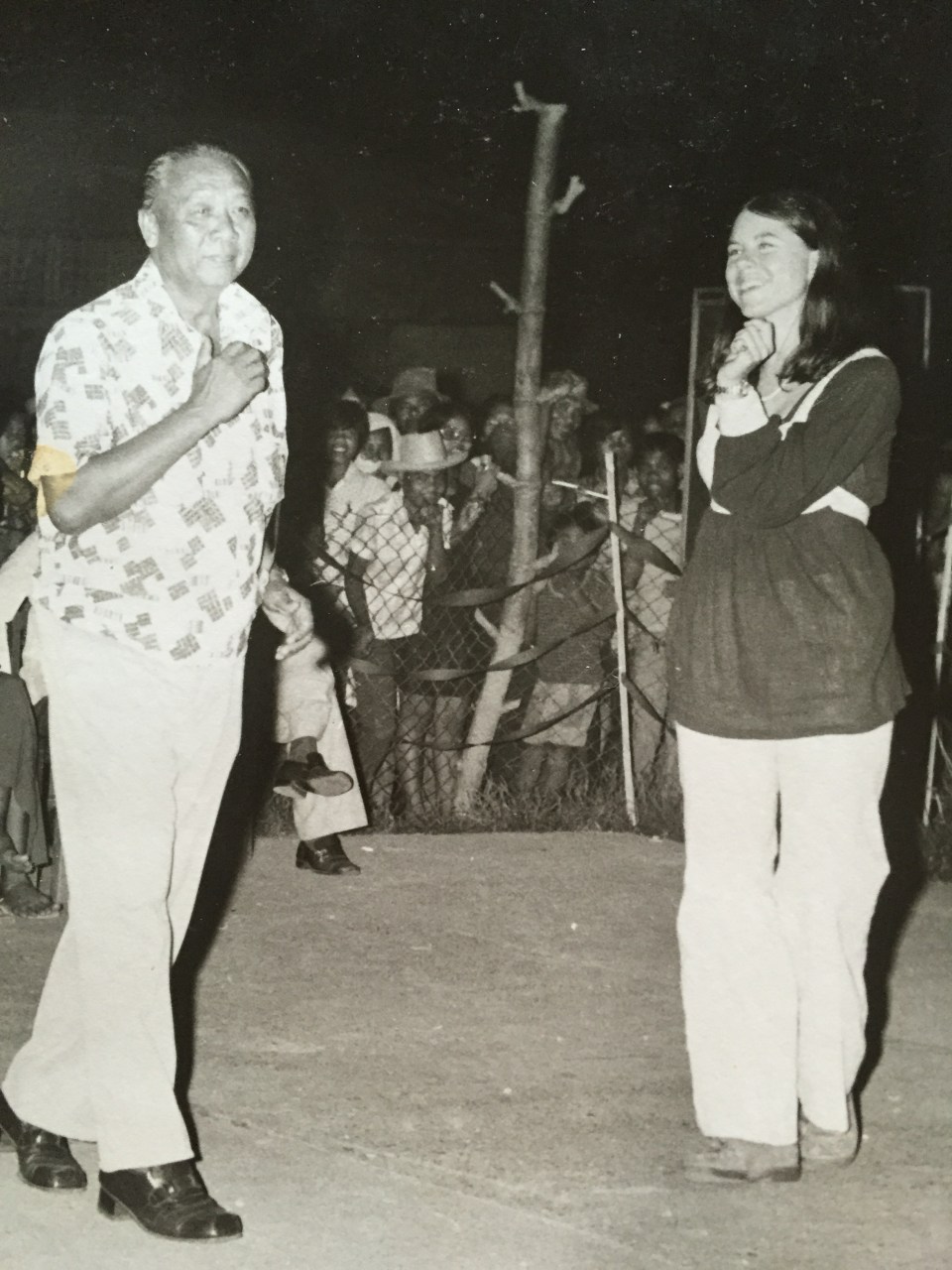
June and July have been full of parades, baptisms, death anniversaryies, walk-a-thons, benefit dances, new building dedications, birthday parties, mother’s class graduations, and farewell parties. For everything, there is a reason to celebrate.IMG_0124

There was a week-night dance that until 1:30 a.m. It was exhausting, but I played my role with a smile.  The underboard nurse from Manila, was distressed. She said that she felt like “bait” as our supervisor kept insisting that we continue to dance.  I feel grateful to have another women who sees my point of view. I feel less alone.

IMG_0123

DAncing with Mayor Moscoso

I became Godmother for Cherrie Rivero. The priest spoke about how baptisms had become, to some people, mere social occasions and a means of acquiring material things and/or social standing. Indeed, there was a huge feast at our house afterwards. They’d killed a pig early in the morning and it squealed with an ear-piercing, gut-wrenching sound. It was cooked whole, with head and skin. The final party arrangement featured the pig with tongue hanging out at the center of the buffet table.

For the walk-a-thon, everyone walked 3 km. (about 2 miles) and complained about being exhausted. For someone who is accustomed to backpacking long distances in the Cascades, Olympics, and Sierras, I found it comical.

Some celebrations are informal, but more delightful. At six a.m. one Saturday, several of us went swimming. I’d planned it the day before. It was great to get exercise early and laugh. On another occasion, we were surveying in a rural barrio when the barrio captain brought us young coconuts and milk. I loved it. I’ll never be able to anticipate such little surprises of kindness. They are much rarer back home.

Friendship

Dawning realization
knowing and caring
unprepared unexpected
another human being
has made you smile
brought you close
to yourself

I went with Linda to Mrs. Nava’s  to hang out and have pizza before the birthday party for David. I seem to have friends here now.

Our underboard nurse just finished six months duty and returned to Manila. She’s been here since the week after I arrived. She lived with me at the Riveros. She’s my age. She has quite a streak of independence. This last couple of months we’ve gotten fairly close. She seemed to understand about the things that frustrated me. I’ll really miss her. One day last week I had a good cry in front of her, so we went for a long walk to the beach. It’s good to realize that I feel close to someone who’s not American. I already like a couple of the new nurses too. In general I’m feeling more comfortable around the people here; and vica versa I think.

Today I went surveying with Elen, another nurse. I like her. She’s not a delicate sweet little thing and loves walking fast with me; she smiles. The task was much more pleasant and we had an enjoyable walk home. Attitude can make or break a day.

On Health

Flat-my-back
away-from-home blues
sick abed and adult
without brother to play checkers
in the covers of contagion
bedroom loneliness
no mothers’ trays
no softened voices
no coloring books
that daddy bought
for me alone

There was a huge feast at our house. After the baptism I was hot and not feeling well and have had diarrhea ever since. By Sunday I was sick again with 103° temp and diarrhea, headache, joint aches, etc. It happens everytime I eat celebratory food or drink much of the water. It’s one way to lose weight. I gain weight and then lose it from the bacterial and parasitic infections. How I hate to be ill in this place. I feel so unsafe, so unprotected.

Stayed in bed just about all day. I really hate being sick with no one to ask “How are you?” I know it’s a cultural difference. Illness and even death is such an accepted part of life. Diarrhea is just a fact of life. Just now I’m on my 5th day running (so to speak). The medicine isn’t doing any good. Think I must have more amoeba or worms because I’ve been getting diarrhea so much. I lost another 5 lbs. subsequently I’m  120 again.

At the end of the month I went to Cebu, headed for Mindanao on vacation. I stayed with Patty and we spent Saturday in the city rushing around. I didn’t want to admit how sick I was. On Sunday I woke up late and feeling pretty sick. I couldn’t eat and had no energy, but Patty wanted to go swimming so we went. I’m getting pretty mellow about being always sick. Eventually I started vommiting and had diarrhea. Later Patty and I walked a couple of blocks for ice cream. On peaceful tropical evenings, troubles melt away. But Monday I went to see the doctor in Cebu and was admitted to the hospital. I have confidence in Dr. Gozo. I was ready for the hospital and happy to lie in bed without moving a muscle. Flush toilets are also a luxury one appreciates with diarrhea.  Didn’t get much sleep last because of mosquitos in my hospital room. On Tuesday they let me out of the hospital for two hours to see a Marx Brothers movie with friends. It was too much for me and I got a massive headache. On Wednesday, Linny, Nancy, John, Cayenne, Ken, Angie, Patty, and Bertall came to my hospital room and rented a television. They watched Charlie and ate popcorn. Linny played guitar and sang. It was nice to have company, but I fell asleep. On Thursday I had barium enemas to look for colon damage because I’ve been diagnosed with chronic amoeba-positive stool. This is why I’ve been sick off and on since March. Bummer. The X-rays were okay and I was released from the hospital. Patty wanted me to go night clubbing but I couldn’t handle it. I crashed early.

      For Linny
you lightened my load
Relaxed the pain
breath of songs
from throaty voices
I hardly know you
your sore throat lessened
as I grew happy from your tunes
my pain left
when you opened up
your late night guitar song
to resting ears


Extraordinary becomes Ordinary – June 1975

The ramblings of my journals, audiotapes, and letters from June 1975 were prolific and hard to wrangle. While many calendar jottings were short and documented everyday life, there were also long reflective pieces, as well as  disorganized mutterings into the tape recorder. It is clear however, that in this sixth month in town, I had settled in. Life in Bugasong was becoming ordinary for me, at times mundane. I had fully committed and did not think I might leave early.

A lot of strange things happen here, the sort of things the first 22 years didn’t prepare me for, but I’m convinced that I should live out this thing because I feel that the experience is right for me.

Here are snippets from my journals that reflect the life of a volunteer who has settled in to the work, the community, and the home life:

  • the day begins with sweeping up and preparing for breakfast at 7 am, a merienda (snack) at 9:30 and lunch at 11:30 or 12, followed by siesta. In the afternoon we have merienda again at 2:30 and 5. Dinner is at 7
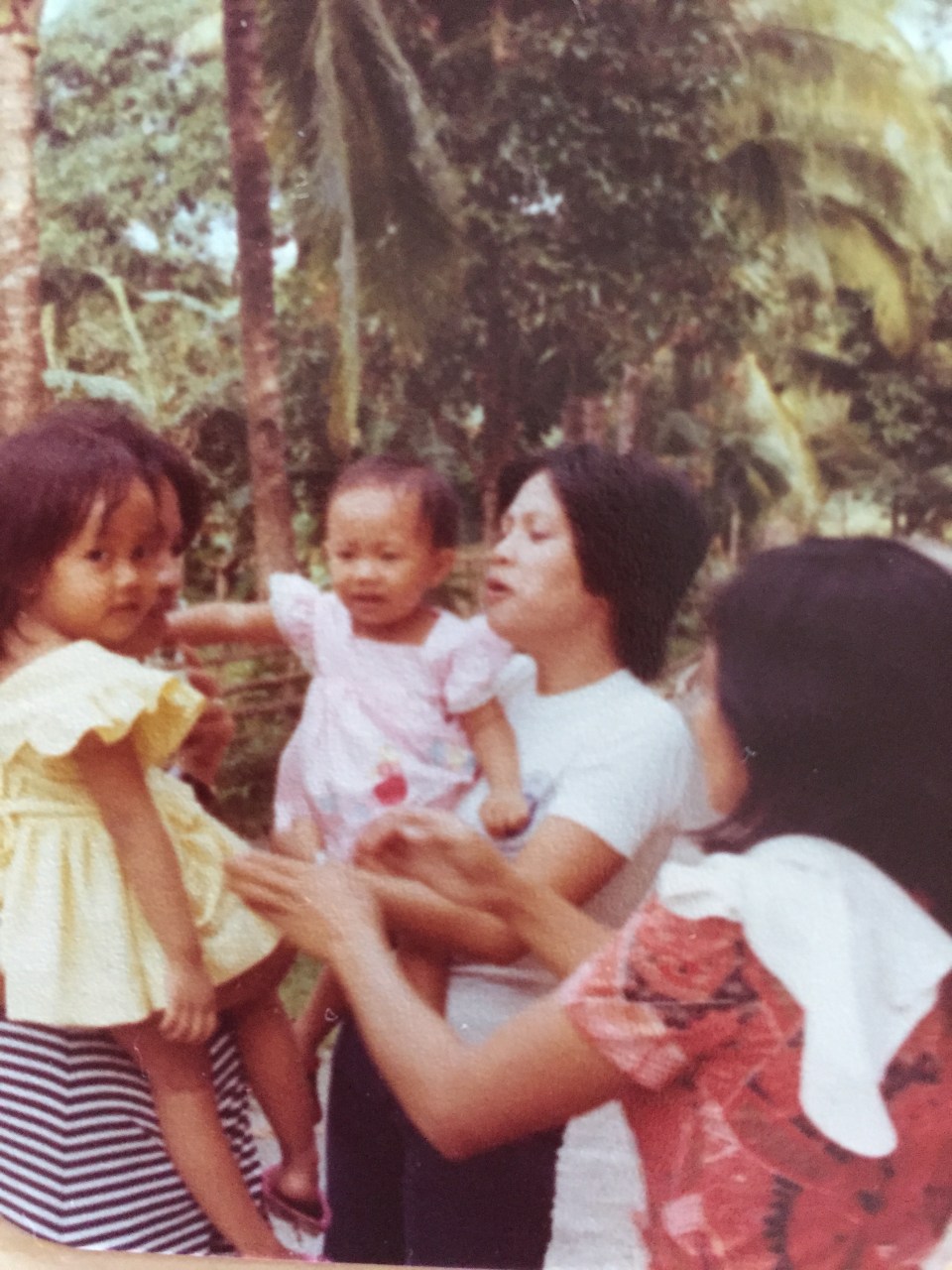
  • played with the babies, Peachie and Cherrie

    IMG_0107.jpg

    Peachie and Cherrie Rivero

  • happily returned in time for sunset, talks, burning leaves, dinner, a game of scrabble
  • a free day with no projects in process, not even a book. Spent time on yoga, a long beach walk in a heavy rainstorm, a conversation about martial law and freedom, a birthday dinner party. I am really here
  • was interrupted for fitting of a blouse made out of hand woven, embroidered fabric that I bought in Iloilo. The seamstress charged me 4 pesos (about 60¢). She’s poor and works so hard. I wanted to pay more. She finally accepted 10 pesos
  • went to Belison for meeting with Dave and Tom. They were happy from their travels. Enjoyed their company, a few beers, popcorn, relaxation and laughter
  • Friday melted away and became Saturday. Days keep coming, always waking in the same bed with time enough to get up slowly and think about my dreams and where I am
  • had 4 vacation days off because Thursday was Philippine Independence Day (martial law style). There was a parade, speeches, and a dance. The parade was fun because of kids
  • walked home in the dark luscious rain. Let us give thanks for the ever cleansing rains falling upon our ironed shirts.
  • early morning I went to market. People are getting used to me, or vica versa. I can enjoy myself in public
  • had fun running around with some grade school kids at the beach
  • the house has quieted down to soft music and babies being rocked
  • met other volunteers for the weekend. Had pizza, a banana split, and guzzled milk on a bench in a park. The time away was fun without being intensified as an escape
  • sometimes feel constrained by a lack of exuberance, presence of inhibitions, or extreme moodiness of other volunteers. It’s all part of friendship though
  • had severe cramps with extreme diarrhea but remained serene and managed to sleep well and deeply. I’m getting used to ups and downs
  • had snacks, paced around the clinic, made small talk, drank coca cola, played with kids, took a siesta, lived like everyone else here

Work:

  • helped doctora stitch up a baby’s head
  • arranged and labeled medicine cabinet, swept, threw out old medicines
  • tabulated  surveys of children’s weight to determine malnutrition
  • went with a nurse to immunize 1st graders
  • was awake early so I went to the Health Center. Cleaned and reorganized. Worked hard. I think the center is much better now
  • spent the morning giving BCG injections for tuberculosis
  • worked with the health unit on Operation Timbang Semininar preparations
  • had plans for a house-to-house survey, but it was raining early in the morning. I hope it doesn’t rain all day every day
  • prepared my speech and visual aids for tomorrow’s seminar.
  • rose early to practice a lecture for 200 people. All went well, but the loudspeaker and crowds gave me a headache
  • began surveying barrio Jinalinan, for Mother’s Class next week
  • will miss Linda when she finishes underboard nurse duty
  • trucked off to San Jose for another meeting with the governor
  • got 44 parents enrolled in a barrio health & nutrition class
  • starting a water purification project to stop typhoid and cholera, but not amoeba unfortunately
  • am busy enough

Rainy Season

What could be more ordinary than writing about the weather…

There are two seasons here:  dust and mud, also known as dry and wet. In the rainy season, my sandals sink into mud and as I pull my foot up, the suction releases the sandal with a force that catapults mud up my back. In dry season, dust cakes to my sweat to create a body armor of clay. In either case, I’m covered with dirt. The local solution is to travel with a towel over your head to keep off rain or dust. When the sun sets, everything is okay again, except for the myriad mosquitos feeding ravenously on my blood.

Dry season is over, it’s rainy season now. I just walked over to the glassless window where I stand and listen to the thunderous sound of rain on a nipa house. Unlike Seattle where rain droops out of the sky in a mist, here the whole cloud falls down in little pieces. I’ve stayed in my room practically all day reading.  One should never pass whole days without wandering under the sky. But it always rains in the afternoons and thunders, just when I want to get out. Dear God, don’t ever let me become an indoor person. After lunch I fell asleep to the rhythmic sounds of the rain and had a wonderful dream about brownies with vanilla ice cream. Oh what I wouldn’t do for a hot fudge brownie sundae, and a glass of cold milk. Oh, but mangos. You should taste mangos. The Papayas are just okay, but mangos are heaven. And it doesn’t matter if there’s no chocolate cake, because I just heard a little knock on the door frame. It’s one of our helpers. I can see her little feet sticking out below the curtain. When I go to the door (the hanging curtain really) and ask what she wants, she offers delicious fried bananas with sugar.

During rainy season I should forget my cherished sunset swims and dusky beach walks becasue every afternoon it pours. I usually put aside all plans for a walk, but yesterday I decided to go anyway. Umbrella under arm, I trekked off to the ocean and wandered down the beach to where the river enters. Just then the sky opened up and began to rain—not cats and dogs, but full grown ocelots and St. Bernards. In the best girl scout fashion, I was prepared. I raised my green umbrella, purchased for 20 pesos. It protected me well for two minutes. Then streams of water began to penetrate my green portable shelter. An hour later, through nonstop thunder storms, I arrived home wet and singing off key.

                   Rain
Moist damp luscious dark
crawling up my calves
dripping from eyebrows into blue
gleaming faces on bare wet shoulders
tingling with life energy

The inside of my shoes and my suitcase that doubles as a bureau, layers of mold are growing, fed by the humidity. I keep washing the fabric in my suitcase with water and bleach. It helps but is tedious.

              June Autumn
Burning leaves smell of October
even now in June,
in the tropics
pleasures dissociate
tap one sense or other
to call up
memory treasures


Town Life

The health clinic where I work is not pristine. The roof leaks in dozens of spots. Scattered pans and other vessels catch the leaking sludge. The dust is measurably thick and the medicine outdated. This week I filled a garbage can with long-expired medicine. But the floor of the waiting room is spotless. The women take a half coconut shell, upside-down (empty of course) and stand atop with one bare foot. The other foot is on the floor. They skate around gracefully on the coconut shell to polish the floor. It does a nice job shining bamboo floors, and equally this painted cement in the rural health center.

Cement, like plastic, seems to be a bit of a status symbol. I prefer bamboo and nipa structures aesthetically and for practicality. They are cooler in the tropical heat. They feel calming and natural. I like the romantic notion of living off the land. In some of our barrios, women weave fabric for their patadyong (tubular skirt). Patadyongs double as hammocks for babies or backpacks for carrying goods. The houses are the same as they’ve been for thousands of years. Nothing’s essentially changed except the plastic mobiles hanging inside the house.

Our town faces the ocean to the west, with no mainland between us and Asia. It’s a long way. We have magnificent ocean sunsets.  In every other direction, mountains rise up from rice paddies. People trek by with hollow bamboo poles to fill at the water pump and carry back to their nipa houses. Tuba gatherers climb the coconut trees at sunset to gather the sweet fermented drink. At dusk fishermen bring in their dug out boats and can be seen pulling in nets. When I walk back to the center of town from this beautiful sunset scene, the nipa houses are crowded together much like a city dwelling would be. There’s more space where the rich landowners own fields of rice paddies or sugar cane; or where the terrain is too rough up in the mountains.

This crowding carries into the culture. People never walk alone. If I walk down the street to the sari sari store (a little store that has everything in it—umbrellas to batteries, food and more), people ask me “where is your companion”. It isn’t only women; the men walk around with companions, put their arms around each other, hold hands, lock elbows. It’s hard to put my finger on why it’s awkward for me. Perhaps being close is a natural part of culture in a small environment. The islands are small. This country is 53rd smallest, or largest—53rd in size, but it’s 14th in population and going up. Families have 10, 11 people.

The people will tell me I’m growing fat. “Matambok ikow. Guapa. Guapa.” Which means, “Oh you’re growing beautiful because you’re growing fat.” I try to say that Americans think skinny is beautiful.  But here, if you’re not a little overweight, it means your family can’t afford to feed you right. My family wants me to grow fat so that when I go back to the states, my father will know that they fed me right.

School started on Monday, June 2nd. According to Manang Nene, an elementary teacher and the older sister in my family, not many of the students showed up for the first three days, so they didn’t really start classes until Thursday. Friday was only a half day. During the second week of school, the students attended for three days because Thursday was Independence Day holiday and President Marcos declared a sandwich day holiday for Friday. A sandwich day is a day stuck between a holiday and a weekend day, and so becomes a special holiday. During the third week of the school year, the teachers will have a three day math conference which about 10% of the teachers will attend. Many teachers attend about one half day total, but others don’t go at all. So students are out on Monday, Tuesday, and Wednesday. At town fiesta,  all children are excused from classes for a week so that they can help their families prepare.

The post office is located on the town plaza, below town hall and kitty corner to the health center. One morning a package for me was delivered at the clinic.  The nurses and midwives were anxious to see what I’d received from the states, so I showed them. The box contained bras that had been sent by my mother to replace ones that were stolen from the clothesline at our training site in Cebu. In Filipino stores, they weren’t available in my size, so I had some sent from the states.  My colleagues at the health center had never seen American bras. They wanted to know what I put inside them. It took a while for me to understand the question, because of course one puts boobs inside them. But the question was really, what else I stuffed them with to fill out the cup.  I said I didn’t stuff them with anything except me. They couldn’t believe it. They kept asking me “What do you put inside?”, and I answered repeatedly, “me”. They finally had to look to see for themselves. So I pulled open the top of my shirt and let the women look down. They reached in and felt inside the top of the bra and realized it was really all me in there. I think they were a bit astounded, if not appalled.


Independence Day

Independence Day seems like an unusual celebration under martial law. Bugasong celebrated with parades, speeches, a dance, and a contest for “Miss Independence”.  They wanted me to compete for Miss Independence as “Miss Pujo” and ride on an Independence Day float, competing with Miss Ilaures, and Miss Ilaoud. There are three barrios that make up the center of town. I live in Pojo. Money is raised by men paying money to dance with the women. People can also contribute to the float. A rich woman in town would sponsor me and double any money raised. All proceeds go to a good cause, the rural health center where I work. At the end of the night, the person who brings in the most money becomes Miss Independence. As a feminist, and as a representative of the nation from which the Philippines gained its independence, I declined. My colleagues at the health center couldn’t understand why I didn’t want to do it. They begged me repeatedly (up 15 or 20 times a day). I held strong in my refusal. They were insistent. I was insistent. I missed a once in a lifetime opportunity to be displayed in a pink sequined formal on a decorated side car to a motorcycle decorated with crocheted table cloths, artificial flowers, and cellophane Philippine flags. At the dance I refused to dance slow dances. Everyone thought it must be due to a mysterious fiancee back in the states. Fortunately only about 20% of the dances were fast music, so I didn’t have to dance constantly. I mostly danced with young college students home on vacation, no old drunk men. I’ve gotten fairly used to being stared at, but am not fond of dancing close with drunk men. It was fun hanging out with my colleagues—the nurses, midwives, and family planning motivators. They’re all women and married, mostly between 28 and 35 years old. We sat close  together and played with each others’ hair and chatted. It was affectionate. Seemed to me like a sisterhood. It was relaxing and I’m glad to be a part.

         Universal Patriotism
         (Independence Day I)
We kill each other within limits
law and custom delay and deny
our guilt transposed
in key for organ hymns
unless John Philip Sousa
claims group innocence
selves-righteousness
Francis Scott Key
or Adolf Hitlerism
parades picnics
Sunday after services
week-day funerals’
home-made picnic pie
tasting scrumptious
of February cherries
honoring all repentant boys
freed of guilt sufficiently
to stand with bleeding men
crying to Father George
their Saturday confessions
of loving women and skirts
that might be dancing
but turn their pirouettes
to black holy innocent voices
praying for red death
and blue return
worship of green and silver
which outlive even wounds
which limp five decades hence
parading for mothers
children eating ice cream cones
forgetting to share their flags
they wave to our caresses.

Carbon Copy in Red, White, and Blue
         (Independence Day II)
After the parade speeches run over
little children sunshine withering
away to ice cream escapes
for bored parents laughing
in their favorite clothes
double-scoops rest atop
inverted triangles of indecision
indicting non-circumscribed wants
from torn minds schooled in true and false
twenty minus two still above average
surprised by chocolate cake and
one half hour of televised lies
away from innocence of quilts
and worlds that could be focused
behind closed eyes sucking thumbs
known so well the pleasures undirected
unrestrained residing juxtaposed to minds
untorn

On the Legacy of War

Got into a conversation about the lack of civil liberties under martial law. I was told that Filipinos are submissive because they are afraid of another war that could devastate them and divide their families. The memory of World Was II is strong.


Self-reflection

For some,
perhaps most,
the years which lead
to liking oneself
are long.

I spend a lot of time contemplating without concurrent intellectual conversations that I might be having stateside. I read a lot and dwell on the ideas, however insightful or dull they may be. This month I also focussed on meditation and yoga. At times my dreams joined in.

I am seeing the sad culmination of a time of looseness, selfness, Sansara and the resultant degenerating spirit.  I have learned many things about myself from my youth in western society—things which need to be outgrown. Now is a good time to discard habits that bind me and retain simple ways necessary to be at peace in the world. I need to engage in an honest evaluation of what I have learned about myself, and the self-discipline to avoid the magnification of errors I have made. I know this will not all be accomplished here and now, but perhaps one more error can be removed and one more joy can be known. To accomplish this I see the necessity of focus, reflection, and self-discipline as a means of cleansing my body and mind. It sounds abstract, like all the things I learn about myself as they are coming onto focus.

If I could only learn to live and love without judging.

Good to feel accepting eyes
speaking from over there
to me, unaccusing
joining me at depths within
taking down defenses
still winning no offensive

To accomplish my inward-facing goals, I set a schedule that included diet, exercise, yoga, meditation, sleep, writing, work, language study, appreciating nature, reading and music. I articulated goals: to be less aware of my self and more aware of others, to learn to listen and hear, to become less vain and more natural, to be less worldly and materialistic. Yoga has been an immeasurable help.

Meditating I saw
the cluttered file cabinets
of my mind
envisioned a bonfire
for the bullshit
keeping me warm
on a rainy mountain side.

I’ve been recently plagued by insomnia. Last night I read and did an hour of yoga before bed. It proves to be the most serene part of the day, and I sleep short but well.

When sleep fell, my dreams chased me, frightened, evaded meaning, but hung on when I awoke.

Yoga and the meditations seem to be releasing that energy promised. Just now, reflecting, I realize how early I arose and with vitality.

         Early Meditations
In the recesses of my vast mind
interweavings of six senses
drop from assorted files
unalphabetically ordered
seeping to the foreground
theater of my present knowing
scenes misplaced
but no less relevant
to the experience
of make-up I will wear
of the final act
which is conception
and decomposition
simultaneous

Finished reading The Glass Bead Game, by Hermann Hesse. In the book a man from an elite intellectual society is sent on a teaching assignment to a Benedictine Monastery. His views overwhelmed me as being like a Peace Corps Volunteer (PCV) in the Philippines:

“the manners, style of life, and general tone of intercourse among the monks was couched in a tempo hitherto unkown to him. There was a kind of venerable slowness, a leisurely and benign patience in which all these Fathers seemed to share, including those with temperments seemed rather more active. It was the spirit of their Order, the millennial pace of an age-old, privileged community whose orderly existence had survived hundreds of vicissitudes. They all shared it, as every bee shares the fate of its hive, sleeps its sleep, suffers its suffering, trembles with its trembling. This Benedictine temper seemed at first glance less intellectual, less supple and acute, less active than the style of life in Castalia (the intellectual society’s community), but on the other hand calmer, less malleable, older, more resistant to tribulations. The Spirit and mentality of this place had long ago achieved a harmony with nature.”

When this character writes back to his society about his trouble in adjusting, the following is the reply he received. Other PCV’s agreed with me that it sounds like a memo we might receive from our director:

“Don’t worry about taking all the time you need for your study of the life there. Profit by your days, learn, try to make yourself well liked and useful, insofar as you find your hosts receptive, but do not obtrude yourself, and never seem more impatient, never seem to be under more pressure than they. Even if they should go on treating you for an entire year as if each day were your first as a guest in their house, enter calmly into the spirit of it and behave as if two or even ten years more do not matter to you. Take it as a test in the practice of patience, meditate carefully. If time hangs heavy on your hands, set aside a few hours everyday, no more than four, for some regular work, study, or copying of manuscripts say. But avoid giving the impression of diligence; be at the disposal of everyone who wishes to chat with you.”

The response above is almost a summary of my life here.

I also read Anthony Quinn’s autobiography called Original Sin and  have been thinking about the line: “We have all been traitors for one simple reason. We have all failed to love.” I think that line is from a movie called  The Magus about a man who falls in love but refuses it. He goes for a secure unattached life. He is later put on trial, not specifically for his girl friend’s suicide but for the thing of which he pleads guilty, “having failed to love”. It makes me wonder if I have ever really loved unconditionally. Or do I always require things or expect things?

    Fairy Tale Love
Rhythmically waves pound  soothe
I remember that other rhythm
my ear was pressed tightly
to the chest of my always fairy-tale lover
it’s still fairy tales when I sleep
whether with a lover or alone

Evolving thoughts on solitude:

“Solitude is the Art of Being Alone Without Being Lonely”, Anonymous

It’s difficult for me to read in a noisy environment with no solid walls. I’d like to dance on a lawn, release myself, or meditate. I’m suppressed by wall-to-wall people and noise. But the people are happy in their noise and off key singing—and I enjoy that. Still, I feel sometimes misplaced—as if I should be in a place of solitude.  And yet it’s so right to sit here now, watching the baby’s eyelids droop, and feeling the vibrations of their rocking through the bamboo floor, listening to soft music.

      Touch of Mind
Ice fills the small of my back uncold
dark coals sizzle at my thighs unhot
voices shout at my neck unloud
spider webs form between my eyelids unseen
realities travel downward undigested
carried brainward in corpuscles
transmitting fantasies sensed

I try to remember the revelation that overwhelmed me just time ago, but am at a loss to know any of it. It’s something that sprung up from aloneness here in a strange culture, or should I say loneliness. My mind was meandering through those border recesses of idea, where thought just meets emotion in the struggle for dominance. The wanderings of my mind now attached to this ink on paper begins to bring it all closer to me. It had to do with expectations of the moment; that in my loving I have always clutched to a belief that momentary joy would some day be neatly packaged, constructing a beautiful memory. (“preserve your memories; they’re all that’s left you.”) Never could I allow friendship to grow into love, for if it failed, its memory would be bitter. So love was protected and moments spent gently, swept off briskly, undamaged, then placed under glass. I saw reality not in the present, but in the form experiences take in retrospect.  But if pain occurs, I now feel prepared to deal with the wanderings of my mind in its acute retrospective nature. I’ve passed through endless treks into the borders of my understanding during these past months of loneliness. My aloneness here has brought me to certain realizations—that alone I can cope with the memories that were once able to consume me. I wonder how long it may take to dismantle my well-developed defenses.

I also seemed to still think a lot about home and friends left behind, as evidenced by writing down a string of quotes from some of the taped music I brought with me:

No Good News
No Bad News
There’s No News at All
‘Cept the New York Times

Why don’t you write me I’m
out in the jungle I’m hungry
to hear you

Everybody
must get
stoned

Can’t remember when I’ve
ever been so lonely I’ve
forgot what it’s like to
be home—
can’t remember
what it’s like to be home

Homeward Bound
I wish I was,
Homeward Bound.
Home
where my thoughts escape me

So far away.
Doesn’t anybody
stay in one place anymore?
It would be so fine to see your face
at my door.
And it doesn’t help to know
that you’re just
time away.


Poems for My Sister, My Oldest and  Best Friend

          Catch a Falling Star
“Where ya goin’, Cherry?”
“Crazy, wanna come?”
oh, but I do
your face told me the necessary ritual
of leaving me behind
would never change your evening Cuckoo Song
or singing Catch a Falling Star while doing dishes
—our sisters’ chore that somehow boys escaped
and put it in your pocket
we accepted  and made a thousand games
i followed your expertise at contriving
save it for a rainy day
games to make the growing easier
never let it fade away
rules of the land and how to live
with big people—parents and such
we have a pocket full of starlight and secrets
your wisdom, my innocence
save it for a rainy day
I grew lanky when you wore stockings
your friends couldn’t smile
the worst sin—you had no time
for dishes, for sister chores
I left salt tears in ivory soap suds
had I grown one inch too tall
would I enter uncaringness, big peoplehood
what use is starlight in pockets
when there’s no one to share
but you came back at 2 A.M. after work
we ate brownies and ice cream
alone in your green room with secrets
we emptied pockets and filled them
I helped you pack for college
made brownies or cookies every day
to have time alone with you
so beautiful you were reaching back your hand
to want to be with me who later went on
to other outstretched hands
trusting unknown people
crossing oceans, climbing mountains
always carrying my pocketful
reaching out to you sometimes
sharing separate experiences
or childhood red-bed memories
and poems that we save for rainy days

                            Airmail
just because you’re there and i’m not
i’m sending airmail thoughts when i think them
colorful stamps when I have them
poems when i write them
jokes and sarcasm thrown in with my moods
carried by planes perhaps from Boeing
where dad earned our college tuition
for baccalaureate words we share
across oceans and over mountains
some people use all their words by forty
spend all combinations by sixty
not us we’ll have uncollege things to say
if we ever sit and brush each others’ gray hair


Martial Law, Toilet Molds, and the Prime Directive – May 1975

May (1975) brought a tropical season change: insect season. Some call it rainy season.
I like the thunder and lightening but could do without big bugs and mud.

Returning to the province after two weeks gone  brought back memories of earlier frustrations involving cultural adaption and the felt need for privacy and independence. This time I am less frustrated and, as in Thomas Mann’s The Magic Mountain, I expect the lengthening of my experience here to be accompanied by an acceleration of the perception of time. Indeed, I am quickly falling into a comfortable routine of writing letters, reading madly, eating well, culturally blending and interacting with the family, spending afternoons with health center colleagues at mother’s classes, and feeling better about myself. For the first time I ask—”Where does all this luscious time in a day come from?” And I keep wondering, “What person I will be after this experience?”

I find myself writing letters and journal entries about ideas and making feeble attempts at analyzing the world around me. It occurs to me that living in a different place both environmentally and culturally has allowed me to grow and make meaning of the habits I’ve acquired from a middle class life in U.S. I’m having intricate, distressing dreams, perhaps a manifestation of my mind trying to sort itself out. I’m definitely in a mind-expanding period.


On Politics, a Governor  and Martial Law 

(May 9, 1975)
Bob, Tom, Dave, and I met for hours with Governor Javier and then had dinner with him. He ran for governor three years ago, right out of college, before martial law. He’s young, honest, idealistic, anti-Marcos, pro-arts, and pro-people. He’s a good man with an honesty and forthright nature that impresses me. He is remaining quiet on many things because of Martial Law. He tries at least to help. When martial law was declared, he almost resigned; but the bishop told him he would only be replaced by a “rascal“. So he stays. He articulated the impacts of oppression under a martial law government and its crushing of creativity. For all the good that may be done under a rigid political system, and there may be successes, this is truly a crime. He talks of the amazing writers, dramatists, and artists who went to prison under Marcos’ Martial Law. All creative thinking has been squashed. The details are incredible. I am continuously amazed at things I learn and people I meet.

(May 19, 1975)
I attended a seminar on the National Nutrition Project at the provincial capital. Only five of eighteen mayors bothered to show the first morning, and only one attended the afternoon session. I am so frustrated by bureaucracies, especially under martial law. Sometimes the hope of organizing to improve conditions seems useless, but on the second day I was pleased to see better attendance by physicians, school supervisors, and others. These paid officials who were not elected or appointed through politics seem more invested in community welfare. Still the system seems to limit creative approaches. There seems to be a lot of attention paid to dogma and any government document. Sometimes I see built-in inefficiencies or strategies that have no hope of success. I get frustrated and don’t know how far I should interfere.


On Violence 

(May 11, 1975)
My life after Peace Corps had been headed toward medical school. Watching the two doctors in my household, I am now feeling compelled to turn away from that path. Regularly at the house, where Dr. Rivero has his clinic, we experience a string of night calls. Patients are stitched up, or otherwise attended to, right in the front room. Last night there were two simultaneous calls that were too serious to be treated in the living room. The petromax (like a kerosene camping lantern) was moved to the tiny, one-room, cement block clinic attached to the house, so that Dodong (Dr. Rivero) and Evelyn (Dra. Rivero) would be able to work. My little kerosene lantern became the only light in the large nipa house. We brought it to the living room to finish our Scrabble game while the clinic was made ready for the patients. The house was ominous with only the dim light. When the clinic was ready, I went down to help the doctors. There they were: two blood-splattered victims of two separate fights from two different barrios; both thoroughly drenched in blood, in colors more vivid than I had seen in war movies or Newsweek clippings. One man had a deep side wound. He looked grim. He’ll be lucky to avoid peritonitis and death because his stomach and probably his diaphragm must have been punctured. The two women with him were pale, I assume from nausea and worry. It takes a lot for naturally dark skinned people to appear so pale. The other victim was medically in worse shape, but smiling, almost laughing. I’m sure the smile will diminish as the drunken stupor wears off. His head and entire body were streaked with the blood that was beginning to flow a little more slowly from the numerous gashes in his forehead and head . He smiled at me from his blood-smeared face as if it were a social occasion. I soon decided I wasn’t needed and left. Etched into my mind was the reality that violence can be experienced as a fact of life; accompanied by a full range of emotions, from humor to terror. It’s easier to see now how war becomes norm.

I appreciate now the innocence of my childhood. Living with a doctor’s family in the rural Philippines, one’s sensibility and one’s stomach must become conditioned to going from scrabble to bloody wounds, to dinner. But last night I became nauseous and couldn’t eat dinner. It reminded me of the time I nearly passed out in surgery when working at the veterinary clinic after a day with four midterm exams followed by clinic work that included standing for 45 minutes in a small stuffy room while I consoled frightened pet owners and simultaneously applied emergency pressure to a badly bleeding dog. This time the blood was human, the violence was senseless, and it was not the standing through surgery, but the carefree smile on the blood-smeared face that made me nauseous. I watched the two doctors clean up the mess, argue about payment and return to dinner. I watched with a crystal clear awareness that, if luck holds, the men will live to return again after the next drunken barrio fight. I wondered, “Is it a service, to stitch people up and send them back to the same conditions?” It makes me reconsider my intention to go to medical school. I want to impact the underlying conditions and change the expressions on the faces, not just patch the wounds. Medicine could have been a passion with me; I have changed my mind. This experience gives me a tangible understanding of why medical school may not be the most fulfilling path for me.

      Night Clinic
Widening social smile
eyes still laughing
in drunkenness nodding
across the room I stand
returning a social nod
forgetting the nausea
that would greet
the blood smeared face
the gashed-in head
above a soaked red shirt
hands just moments ago
engaged in violence


On Religion

(mid-May, 1975)
I attended my first local wedding. In the front of the church was an altar with flowers and a table full of fruit. It oddly reminded me of some pagan sacrifice, though I didn’t ask the purpose. The young Filipino priest was quite ceremonious and theatrical. When communion was offered, the congregation became serious as they marched up to receive a wafer. It seemed as if many passersby joined, in the middle of the work-day, perhaps as a break in the tedium. I wondered if the serious faces mirrored a reflective spirit, fear of God, or superficial habit. Just then I took my first real notice of the giant altar. The art is primitive and I’d never really noticed before. There is a giant caucasian-appearing Jesus with sad eyes on a wooden crucifix looming half way up the endless wall to the towering ceiling. Painted on the wall at the foot of the cross is dripping blood falling ten feet or more into a golden cup that rests atop a painted globe. Standing on the globe to the left and right of the cup are two ill-proportioned calves, I think, drinking the blood. Immediately it struck me how much the martyrdom of Christianity has repulsed me. Martyrdom can be the catalyst of the guilts and fears which have caused wars, insanity, and more. In the U.S. I think we mix three parts guilt to one part fear. Here in the Philippines they’ve made their own form of Christianity with a ratio of three parts fear to one part guilt. I won’t judge which is better, or easier to overcome. This fear can run just as deeply as guilt. A small example: tonight when it thundered, as is common in the rainy season, the adults told the little children that Jesus was angry. The emphasis was completely on the fear. There was no hint that the anger was because any one had transgressed, just that Jesus was angry. I could envision adults in the U.S. speaking more to anger over sin, hence invoking the guilty conscience.

Early in the month I stopped in Iloilo City, to see some local embroidery. The embroidery was very fine, delicate and quite expensive. It is purchased for the clothing of Ferdinand and Imelda Marcos. I learned that the place is actually an orphanage run by nuns. Even the young 6 year old children were weaving and embroidering amazingly intricate pieces. But I learned that the children go blind from the work. I wondered how the church could sanction this child labor; yet certainly the children are better off than the street children I have seen.

From a billboard in Iloilo:
“Sexual orgies are gravely sinful. Beware of God’s anger”. (I believe that orgies are about as common here as a snowball in hell.)


On Patience

Some hours, days or weeks,
when melted into the past,
have served no purpose
other than to test
or strengthen one’s patience

(May 13, 1975) –

The Unexpected Guest (or The Saga of the Toilet Mold Expedition) 

On Tuesday I needed to travel to Aklan province in the north to pick up my toilet molds from Neal, another volunteer. He had transported them from technical training when I could not becasue I was flying. I intended to go to Neal’s town in the adjacent province, pick up the toilet molds, and return to Bugasong in one day, possibly two. I wrote the following account of the trip in a letter to my sister using the third person:

The adventures of our bedraggled character lead us this week around the island of Panay, a small dot in the vast Pacific Ocean. Alas, we find our audience perched on the very edges of their chairs, awaiting the details of this next epic. So, we begin our tale. Tuesday morning we find our intrepid Peace Corps Volunteer crawling out from under the mosquito net at 5 a.m., the sun still asleep just beyond the eastern horizon. After packing a few things and munching down the usual cold fried egg and rice breakfast, she descends the wooden ladder of the nipa house to the “National Highway”, aka dirt road, to await transportation heading north to the town of Pandan on the border of the province of Antique. Our young woman, a painfully slow reader, casually reads 60 pages of a novel as she ever-so-patiently awaits a jeep. At 10:30 a.m. the first jeepney passes. But alas, the seams of the jeepney are bursting and even the roof carries 6 passengers. There is no room. Faint and wishing to avoid sun stroke, our friend decides to take the long route south, around the island. Transportation will be more available along this alternate route. And so, shortly before noon, our peace corps volunteer takes a jeepney south, away from her destination. She arrives in San Jose, Antique’s provincial capital, by mid-afternoon, and we soon see our young dusty woman transferring to a bus headed for Iloilo, “the big city” and provincial capital of the neighboring province, Iloilo. On the long bus ride she reads her newly arrived MS magazine and most of her book, sings songs and is quite content, knowing that she has traveled a negative distance toward her destination but will be able to catch an express train north the following day. And so, our traveler having arrived in Iloilo late in the day, must stay overnight with a friend as an unexpected guest.

Early the next morning, our energetic volunteer takes a tricylce to the train station early enough to catch the 9 0’Clock Express to Roxas, provincial capital of Cadiz province in the northeast corner of the island. The train is the most reliable transportation on the island, and so the young woman rests assured that her troubles are over. Three hours on the train and three hours by bus will bring her to her destination, though unlikely early enough to retrieve the toilet molds she seeks and return to her home village that day. With a comforting rhythm, the express train departs. After an hour or so, the train comes to a stop a rice paddy nestled in a green valley, surrounded by lush mountains, with no barrios in sight. Our young Peace Corps Volunteer enjoys the view, glances periodically at the water buffalo in the field, and continues to read. Though curious about the unexpected delay, it is difficult for her to inquire because the passengers and crew speak a different language in this province; a language she does not know. So she waits silently, even as most of the passengers disembark and board a train heading back to the point of origin. When hunger sets in, our resourceful volunteer buys peanuts from the sole person left on the train. She hopes that food will take her mind off the fact that she is chilly and quite wet from the thunderstorm that drenched her through the open-sided train car. To her dismay, she finds the peanuts sugar-coated. But what does it matter; most of them landed on the floor when the bag broke. The ants will take pleasure in the sugar.  After four hours, an engine arrives from Iloilo city and pushes the train to a side track where a broken axel is repaired. By the time the train arrives at it’s destination, the last bus to Aklan has departed. So our hungry traveler indulges in ice cream and catches the last transport to the nearby town of Ivisan where she can surprise and spend the second night with another Peace Corps friend. How nice.

The following morning, day three of our journey, the two volunteers awaken at 5 a.m. to make absolutely certain that our determined traveler will catch a 6:00 or 6:30 or 7:00 a.m. bus. But all the buses are broken today. Late in the morning, a bus finally arrives and off she goes to the town of Atlavas in the northeastern corner of Aklan province, bordering Cadiz province on the west. Here the wandering volunteer learns that the person whom she intended to meet is not actually in his town, but is visiting another town. So our traveler walks back to the main road, catches a bus, transfers to another bus, and finds him in the town of Lezo. It is evening and much too late to return to Batan to retrieve the toilet molds, the original purpose of the trip. So pur persistent traveler remains overnight, as an unexpected guest, in Lezo, where another Peace Corps friend resides. Its fiesta in Lezo. What a nice surprise. She reads some more and takes things as they come. So it goes.

On the fourth day our peace corps volunteers have breakfast together at 6:00 a.m. in order to catch an early ride into Kalibo, the provincial capital of Aklan. This is the fourth and last  provincial capital of the trip, most likely because it is the last provincial capital on the island. The other volunteers have now joined the trek to keep our wearying traveler company. For some unknown reason, perhaps because of fiesta, there are no tricycles to be found. Our companion travelers wait three hours for a 20-minute ride to Kalibo, where they can catch a ride to Batan, where the illusive toilet molds await. Walking would have been faster, though hindsight is always twenty:twenty. After a one hour wait in the bank to cash a check, another hour waiting for a jeepney, yet another hour waiting for a transfer to a second jeepney, and another wait for the ferry to Batan, our hopeful volunteer is excited that her mission is soon to be accomplished. The toilet molds will save her 2½ weeks of work and 220.00 pesos. When she arrives in Batan she learns that by some unfortunate mishap, the toilet molds have been destroyed by the townspeople. What fun it must have been! Our group of young volunteers have a nice lunch in Batan and then our traveler reverse engineers her trip with travel by ferry, jeepney #1, jeepney #2, and jeepney #3 to the town of Navas on the western edge of Aklan, where her fruitless journey can come full circle with a four hour ride home the following morning. She stays over night in Navas as an unexpected guest with yet another Peace Corps friend. The town was enjoyable, so our still intrepid traveler mellows into the situation, exchanges her completed books for new ones, and accepts the week for what it is, an adventure.

On Saturday, day five of the adventure, the two Peace Corps buddies awaken at 5:00 a.m., because early transportation is definitely the most reliable. Everyone was surprised that there were no early morning jeepneys or busses to Pandan, the northwestern-most town in Antique province; everyone except our much experienced traveler. She no longer has expectations of timeliness. After the inexplicable three hour wait, our weary but accepting traveler boards a bus headed southward. There is an hour delay in Pandan before the bus proceeds southward, still to detour for mysterious reasons near Culasi and Barbaza, arriving in her home town of Bugasong as the afternoon wanes. Perhaps the trip was not for toilet molds at all, but a study in patience. Alas she has traveled round trip 150 miles in 5 days.

Later in the week our volunteer encounters three rides in jeepneys which break down. One tire explodes; actually the rubber shatters into a million pieces all over the road. There is almost an accident as the jeepney careens off into a rice paddy. Although that tire is replaced, and two additional tires are replaced, our young Peave Corps Volunteer eventually must hitch a ride with the priest to get back to town. She is thinking she might stay put for a while.

       Journey
dirt rmountain roads
patched-together jeeps
open air busses
eyes blinking dust
reading books that jerk
arms squashed tightly
passengers packed densely
others not quite knowing
why I sing so peacefully
away from freeways
and Greyhounds


On Health Care

I Want to Die at Home (May 23, 1975)
On Friday morning I knew I was seriously sick. I went to the telegraph office by the town plaza to send a cryptic telegram to Bob, Tom, and Dave, telling them I was comnig to Belison and would need help. I squatted by the side of the road waiting for a jeepney, too weak to stand. My abdomen hurt so badly that I seriously felt like I would burst. I finally realized that I would not be able to not handle the ride to Belison, so I carefully walked across the plaza, barely making it to the rural health center before passing out. I’ve never felt such pain. I needed to defecate to release the pressure, but began to expel about a gallon of water. Such pain and fever. My skin turned blotchy, bright red. I wanted to die, in fact, I was afraid I would, out here, so far from appropriate medical attention. I could sense my blood pressure dropping with that unmistakable awareness that I was going into shock. I thought about the fact that I might very well die. In my semiconscious fuzziness, shortly before I went unconscious, I remember clearely knowing that I didn’t want to die in the Philippines. I accepted that I was probably dying and with crystal clarity decided to go home first. My feisty willpower was not matched by any external effort, as I was unable to lift my head or move. I remember becoming briefly conscious again. The doctor or the doctora gave me a pain shot. I lay on a grungy mattressless bed in the rural health center, so badly designed by Imelda Marcos’ architect with a roof that had previously collapsed under tropical rains. It was no hospital or overnight facility. I lay there on a bare cot in an empty closet-like room, unable to move. I drifted into consciousness once or twice and remember that lolo tatay (Manuel Rivero senior, the father/grandfather in my family, a tiny, feeble old man) came with a pedicab (a motorcycle with a side car) to fetch me. Lolo tatay was caring and gentle and patriarchal in his concern for me and determined to get me home to safety. They walked or carried me to the pedicab. Every time I was conscious, including then, I begged them to send a telegram to the volunteers in Belison to get the Peace corps to med-evac me. No one did. It was frustrating. I don’t arriving at our nipa house or going to my bed in the draped off space off the living room. They must have carried me up. I awoke after almost 24 hours, amazed to be alive. The following day I was weak and achey with occaisional minor cramps, but on Monday I went to language class in Belison and then slept more.

After being so sick, I’m incredibly lethargic. On Tuesday I go to Sibalom market with Renee and David for language training, but are all rather asleep as we move around. The heat is stifling. When I return to Bugasong in the afternoon, time passes sleepily.
On Wednesday David and Renee and I go to the river in Talisay. I must admit, after having been so sick I’m not really into hiking through the muddy rice fields. David feels the same because he has a cold. But we do it and have a nice mellow time talking with barrio people and having a picnic and good conversations.
By Thursday I’m back in Belison for language class but am physically drained, either from yesterday’s hike or because I’m sick or it’s just my head, so I’m heading to Iloilo to see the doctor.
On Friday, May 30, 1975, Doc Mombay decided to put me in the hospital for tests. They took my temp and b.p. and X-ray and then brought me to my room. I’ve been here for 3½ hours just reading, relaxing, and enjoying privacy and air conditioning (and a regular bed!). There’s even a nice crucifix on the paneling to protect me. It may not be so pleasant once the tests start, but just now it’s the most luxury I’ve had since I went in for my tonsillectomy in December.

      Lethargy
Bombarded by emotions
from the core of a reality
that is mine alone
lethargy and lack
of human interaction
drown my physical being
and time sense
leaving an insanity
that belongs to each
in unshared hours

People have stopped asking “matambok ikaw?”  = Are you growing fat? Now they ask “maniwong ikaw?” = Are you growing thin? Filipinos can be blunt about physical appearance, for example,  when you get a pimple, some one is sure to loudly ask, “hey!—what’s that on your face?”


On Cultural Interference
Or The Prime Directive

I really long for some time away from here wandering the vast forests of the Cascade Mountains. Being in my element. It’s beautiful here, enough to compare with picturesque movies in tropical island settings. But I haven’t developed a passion for the landscape. Is it too soon? I think the living conditions overwhelm my relationship to this place. People live off the land, but the individual has no piece of that land, no space. Even in the most underdeveloped areas, like this province in which I live, it’s “rural” yet densely packed with people. There is no “aloneness” or solitude. In my priveleged experience, I imagine mountains, the tropical greenness, and oceans to be synonymous with serenity, peacefulness, and vast open spaces. My disappointment, however unrealistic, can be suffocating. I guess my job is to do something about the living conditions, specifically sanitation and nutrition.Yet I have a dilemma. I feel it unethical to attempt to change the culture. This is not my culture to change. I am the guest here. In my own country it was my right to defend with words or argue any of the cultural values and and traditions. But here, I can’t condone the Western egotistical mingler. Its the Star Trek Prime DIrective: Never interfere with the development of a society. And yet here it is obvious that East and West are mingling and will perhaps eventually become homogeneous.

Sometimes it seems to me that the Philippines is adopting all the worst of Western culture, repeating our mistakes: capitalism, plastic, violent movies; how rapidly these are assimilated into a society. Of course they have the right to make the same mistakes. But what of the good features of Western culture– environmental awareness, value of women beyond “beauty” or “motherhood”, value of men beyond material worth, value of college as a place of education rather than an institution to grind out status. Although Western culture falls vastly short in these areas, these concepts are pondered, not neglected. Women would generally think twice before allowing themselves to be “auctioned off” at a local benefit dance. Yet here in the towns and barrios of the Philippines, it is touted as an honor. Nearly every home and vehicle displays a postcard picture of a Miss Universe contestant, or several. Beauty, appearance, clothes, style, symbols of materialism are practically worshipped. And in such a densely populated country, where the individual is generally hidden, these symbols become the goal. I don’t hear discussions about peace, or the environment, or peace of mind. The greater focus is on status within the social framework. Perhaps its just a matter of time and the same could be said by a visitor to the U.S.

But I digress. I was originally focusing on the danger of Western “mingling”. If this southeast Asian culture has been adversely effected by Western ideas and technology, do I have right now, as a human being among other human beings, to expose the people here to other Western values such as feminism and alternate lifestyles? Can I remain true to myself and the things I value? Can I change the stereotypical view of an “Americana” and the allegiance to the almighty dollar? Can I try to give a better image without forcefulness or tampering with the culture? Next time I’m asked to be a commodity at a benefit dance, can I refuse self-assuredly and attempt to explain my feminist stance? I won’t tell the people they are wrong, only that this thing is wrong for me as a matter of personal belief. Yet trying to give reasons is often interpreted as arguing against the established value system. It’s touchy ground—damned if I do, damned if I don’t. I guess the only real solution would be to return home and remove the source of ambiguity. And that’s no solution either because the conflict exists, cannot be escaped, my life is already many months interwoven with the lives of the Filipino people I live and work with.

So I’ll finish out my two years here most likely. With so many frustrations it’s never been a sure thing. But ideas are growing and a new frame of reference, a new perspective. The way I relate here changes daily, always allowing for new growth and insights. Maybe I’ll reach some peace with this place before I leave. And maybe, I’ll learn how people can have serenity and peacefulness interwoven in a densely populated society. It’s something I’m not yet able to do. I’ll understand why they would miss this place if they should leave—as I now miss and long for the Cascade Mountains, the Pacific Northwest, home to me, more and more each day.

Turning Point April 1975

While cleaning my cubby-hole of a room, I discovered musings that I hardly remember writing, including poems and reflections on depression and elation alternately. Most likely these writings were late night inspirations, without a fragment left in the morning. But this month I’m feeling more comfortable, more relaxed, less dramatic. I’m satisfied spending the weekend in Bugasong talking with family, reading until the light of my tiny amber brown bottle with a cloth wick goes dim.  I no longer find myself distressed and counting symbols of passing time. I’m where I’ve been a thousand times—hours passing and days changing indistinguishably. I’m happy. Something has changed, though I can’t figure when it happened. I’m enjoying the sounds of rain spattering on our Nipa roof, like inside a tent, but much dryer. I love that sound. It puts me to sleep early. The emotional roller coaster has mellowed. I’ve adjusted to the pace, find less need to see other expats, write fewer letters home, enjoy receiving letters but don’t get depressed without mail, am happy to relax with local people. I’m letting rest the things I left behind, knowing it will all be different when I return.

       Transition
Soothing, satisfying sensations
comfortleness snuck in
sideways between the shadows
of frustrations felt forever
in the solitary, sleepless evenings
sandwiched between days
of new experiences
before patience was earned

Work Takes Center Stage

As April began, I felt unproductive at the RHU (rural health unit), except for finishing the wire toilet frame and wrapping up details of the upcoming Mother’s Class. The pace picked up as I focussed on the work I wanted to accomplish before rainy season, with its threat of floods and community immobility. I scheduled two weeks of afternoon classes on nutrition, sanitation, and child care for mothers of undernourished children, accompanied by mornings surveying and weighing children from a future barrio.

I spent the morning of April 7th in the barrio, making friends and reminding mothers to meet us for the first class, just after siesta. When 2 p.m. arrived, I was frustrated by low attendance, but was able to relax and tell myself, “there’s no rush”.  When things eventually started, we were stalled by questions from the mothers: “When will the test be?” “How will we elect class officers?” “Who is planning Commencement exercises?”  As I’d faced the many challenges and frustrations associated with beginning a barrio-based educational program while navigating an unfamiliar culture, I had not, in my wildest imaginings, anticipated these questions. But my fellow health unit colleagues took it in stride. For many of the participants, school was associated with all these things; things they’d missed in life. We also learned that others wanted to join the class, including grandparents, some fathers, teenage unwed girls. So we expanded the classes to be for “parents, grandparents, and out of school youth”. By mid-week things were running smoothly despite my worrying, and attendance was surprisingly high. I found myself relaxed, walking to the barrio, setting up the daily class, working with the mothers, and hanging out talking to colleagues. A friendly part of my personality was reemerging, the part that had been missing in Bugasong—the laughing.

At the end of the two week class, we held a celebratory graduation for our class. I spoke Kinaray-a to a large gathering. We awarded graduation certificates. I seem to be playing out the classic Peace Corps role, though the path did not feel classic. I feel as though something has finally been accomplished.

                   Laughter
like a crocus poking through frost covered ground
laughter breaking the contours of a lonely face
I too have periodic colorful springtimes
all that is cold melts and rushes naturally
wherever gravity claims it’s rights
and the seed of a satisfied life
sends out feelers toward the source

  Side Note about the Work: The Value of Being Under-Prepared and Humble:

Looking back on this early work with the perspective of 40 years experience, I see significance in the details, for example, going to the barrio in the morning to make friends and remind the mothers to come to class in the afternoon. Community work often flounders because the team fails to make personal contact. I remember veteran peace corps volunteers and other local health workers forewarning me that Mother’s Classes would not successful; that barrio mothers would be disinterested or too lazy to attend. After probing and listening to local people, I tried anyway because I suspected that past programs had failed for a myriad of reasons, including such things as scheduling classes to be held weekly, when the mothers in the barrio did not operate on a weekly schedule or pay attention to any day of the week, except “market day” of course. Some classes had been scheduled for 1 p.m., not allowing for siesta which is so critical in a tropical environment with a standard of living that requires building fires to make meals, going to the river to wash clothes, pumping water to wash the baby. I’d gone house-to-house and talked with every mother in the barrio. I shared my passion, and by their responses, I knew they cared deeply. Before I started the program I held a symposium in town. I started the symposium stating an assumption I would make:  that we all had a singular goal in common with every barrio mother, for healthy, happy, thriving children. Then I put up two visual images of a healthy child and a severely malnourished child. I’d commissioned a talented local person to sketch these poster-sized pictures. We brainstormed about the elements that contribute to the malnutrition. We followed that by giving everyone spokes of the wheel to fill in what would support a healthy, well-nourished child. We placed the spokes around the image of the well child noting that every spoke is critical to the functionality of the wheel. This approach equally validated everyone’s contribution as we created the mothers classes to be most effective for the child. The nurse and doctor, the school principal and social worker, the sanitary engineer and the community garden specialist, the agriculturalist and the soils expert, the family planners and midwives all contributed. Each of the local experts shared their perspective on preferred elements for the educational content of the program. Then we discussed the pros and cons. After one family planning expert shared her content, another person mentioned a woman who died from an IUD infection and it was recommended that content around IUD’s take a back seat. In another barrio a person had fallen in to a pit toilet, so we decided to make visual aids to demonstrate how the water seal toilet would not be placed directly over the pit. We tweaked the content, got to know each other’s content, and strategized stories to bring the content alive and complement each other. I had not been taught to hold a symposium or bring the local contributors together in this way. I had never seen a similar approach. It was a creative discovery that came from  my frustration with the cynical veteran volunteers and other naysayers who’d warned me that the program would not be successful. I was also pushed to this approach by my lack of confidence and awareness of my own language limitations. I had a humility that was justified by reality; I possessed only rudimentary knowledge of community based health care work, the local culture, and the local language. I designed a planning program to gather as much information as possible and to let those with local knowledge take the lead in content development and cultural understanding. I served as a catalyst by my status as a foreigner and my sheer passion for the work. People were willing to come together for the “Cana” (Americana).

At the end of the month, I attended a technical retraining program in Cebu City. I interviewed and was accepted into a Parasitology Class at Valez Hospital. The class was supposed to prepare me to  set up a make-shift laboratory in my village to diagnose parasitic diseases and tuberculosis, which are often treated without laboratory confirmation. The laboratory never became a reality. Still, I enjoyed the academic class. I was surprised by what I remember from college and enjoyed the instructor and my fellow students. I spent my one day off making visual aids with Pat and Linda. Other volunteers occasionally dropped in to chat. I enjoyed the crafty, hands-on aspect and planned to use the posters in my Mother’s Classes.


Slowing Down, Enjoying Life Around the Edges –
Beyond Work

While the work is now feeling successful, I have found the need to adjust to a different pace and work ethic. I’ve had the slows about everything lately. One weekend was spent gloriously alone in the Nipa Hut on the Belison beach, just lying in the hammock, reading, sleeping, eating, playing solitaire, writing letters, and watching the colors of the day come and go. It was very relaxing and mellow. And I really enjoyed a pace much slower than I ever could have a year ago. You might even think I’m blending into the local culture.

It’s summer now, and hot. I have developed the ability to get cold here whenever the temp. drops below about 80° (which is only at night and only on occasion). My metabolism begins slowing as the heat and humidity rise. My eating hasn’t slowed. Everyone keeps trying to get me to eat. Their concept of beauty is fatter than ours, so they compliment me if I gain weight. There is a lot of inactivity, with long nights of darkness and no electricity, and daytime punctuated by a siesta. I try to do an hour of exercises daily, but my big interest seems to be reading. I’m nearing the end of my short book supply. Over these first three and a half months on assignment, I’ve spent a lot of time lazily reading for pleasure. I’ve been conditioned to devalue myself when I”m spending time on seemingly unproductive pursuits. When I gain weight and don’t get anything done at work, I feel unproductive, ugly, lazy, depressed, even though I enjoy just laying around reading or hanging out with people. Some personal discipline doing yoga and strength exercises really helps. Learning to better balance work and life, and not be tied to a work clock is a desirable take away from my life here.

Even during my city time I enjoy slow-paced living. When I traveled to the city for technical training with my fellow volunteers, I found city life hectic and enjoyed when I could have a quiet day away from the crowd.  The city was giving me headaches. In Bugasong, where I’m sandwiched in between mountains and ocean in a fairly inaccessible province, I’ve gotten completely out of the rat race. The “big city” has shown me how much I like my town. I’m feeling a need for simple happiness without self-centered pursuits like the many men seeking prostitutes.  The thing I enjoyed most was not partying, but easygoing, unscheduled life with little luxuries like hot showers, flush toilets, electricity, taxis, movies, friends, etc. One day James, Toni, Inday and I walked up to the Trappist Monestary Guimaras Island off Iloilo. Beautiful view and cool breezes. Then James, Toni, and I met Mike Z. and Neal and we went to dinner and a movie.

It is true that some of my slowdown may be due to illness that makes me tired and nauseous a lot., some days vomiting. When I went to the city for retraining, I ended up really sick in the hotel the first day before everything started. I spent an evening and a day in the hotel by myself and got so sick—diarrhea, fever, vomiting—the works. Other evenings I went to bed early with headache and fever. Many times I can’t eat much.  I’ve always got a painful side, probably a swollen liver. Some type of hepatitis Dr. Dodong thinks. Such is life. It’s not bad so long as I don’t do much exercise or stay awake too long. Can’t eat much either. Actually I’m pretty much carrying on as usual except for sleeping about 16 hours. But even that isn’t noticed much in this culture

Revelation—I’ve discovered a new way of coping when I walk and people point (mosty kids), stare, and shout “Cana” (for Americana). Now I just point back and say “Pina” (for Filipina). It works. Everybody loves it. If they call me “Joe” (for GI Joe), I respond with “Hi Phil”, and they laugh.

News Flash !!!!!–

The doctora (who I live with and is more or less my boss) had her baby at 9:40 A.M. on Wednesday, April 9th. I’m going to be the Godmother, and the custom is that the parents may ask the Godmother to name the girl. It’s a girl. They named their first girl “Peachie”  So I decided to name the second girl Cherry after my sister. (It would have been “Cromwell” if it was a boy!) They planned to use the name Cheryl (my sister’s real given name) and only use Cherry as a nick name ( I never told them….they just figured it out that Cherry comes from Cheryl). However, my sister had not liked that name and officially changed it to “Cherry”. So when Evelyn and Alfredo (Dodong) were registering the baby, I convinced them it should be Cherrie because that’s what everybody would call her anyway. I told them that if they gave her the name Cheryl, she might hate it when she grew up. My persuasiveness was effective because she is officially “Cherrie”. I also learned this week that my sister-in-law is pregnant and I will miss the birth and first year of my first niece or nephew. A little twist of fate I guess. I’ll get to watch Cherrie grow up.

Left Unsaid

I’ve shared so many conversations
and pieces of me given to you
in my imagination
miles away you read my poetry;
telling you who I am
we now meet in smiles,
exuberance,
and superficial conversations
leaving my corner in your mind
empty

To my friends—

We can dance, we can smile, we can drink
we can talk ever so pleasantly
share our last frustrations
but can we give each other
simplicity and ideals

Seeking Inspiration, Finding Cockfights

March 1975
Christmas

The plane I took from San Francisco to Manila lasted 22 hrs. I received packages in March that had been airmailed three and a half months earlier. The green paper Christmas tree served our St. Patrick’s Day celebration. The many Christmas packages included three cakes in cans—fruitcake, pineapple nut, and chocolate chip. I received a recipe for peanut butter cookies which I proceeded to make for my friends. A packet of Christmas letters included one from an older couple that sat across the Greyhound bus aisle from Reno to Albany. We’d become friends and shared fruit and pastries. Another card was addressed to “Marilyn the pretty girl”. It was from a little boy at camp, one of the biggest trouble makers at a camp for 9 – 14 year old troubled youth. My past life brought joy into my nipa hut.


Weekend of 3/1/75 and 3/2/75 –
A Cockfight and a Dance

Saturday I typed the last of my proposal for the Municipal Nutrition Council then strolled to the beach for a swim. Finding some privacy made it easier for me to smile later. On Sunday I walked 18 kilometers to Patnongan for fiesta. Locals thought I was crazy, but I was entertained by friendly conversations with multiple people who’d join me briefly as I passed by their nipa home or barrio. I enjoyed the long stretches of dirt road through pristine tropical terrain unmarred by telephone poles or traffic.

Many men spend carefree Sundays at the cockfights, gambling with what little money they have. Everyone said “girls can’t go”. So I was compelled to do so once. The mayor of Patnongen (a very nice man, they say he’d be governor if he hadn’t opposed martial law) invited me,  so I saw my first cock fight. There were people from several provinces present, including many mayors and local dignitaries, but as the only woman, my presence was announced. It seemed acceptable for me to be there, perhaps because I was a foreigner, or because I was the mayor’s guest. I was warmly welcomed and sensed no implication of scandal. I watched the betting, crowd interactions, and nuances of social drama. The blood and killing of the birds seemed very tangential. I’m not even sure I watched it as I stood in the crowd with many taller men. Today there is more awareness of animal cruelty. I wonder if that has spread to the Philippines? In 1975 it was not even mentioned, though it was understood that girls and women thought these events were somehow uncivil or even barbaric, so there must have been some recognition that “mom would not approve”; you know, that corner of your brain that says “this is wrong”. On the other hand, perhaps it was only the drinking and betting that was disapproved; the cockfighting may have been tangential for the mothers too. The excitement centered on hopes that the underdog (bird) would win. When all was over, the loser was eaten for dinner. After a short while I was simply bored and left. I’d connected with local people in new ways. I think my participation indicated that I did not think of myself above it all, standing separate and judging. I’m not sure how true that was, but perception helps. Time will tell. Barriers are breaking down and I’m beginning to meet people outside the immediate family. Along with the male volunteers, we all drank beer, had good conversations with locals, and went to the dance. I danced with several mayors. (Hamtik’s young mayor is quite handsome.) I had a good time.


Week of 3/3/75 –
Agony and 
Ecstasy

And so the days come and go—one moment needing a friend from my own culture, the next moment needing to be alone; one day finding inspiration in solitary reflection, the next finding I’ve gained a bit from laughing, drinking, and dancing with people I don’t know and don’t quite understand; last week excited about my work, this week wanting only to sit in my room and read. For two days my time was usurped by reading The Agony and the Ecstasy, spending only a couple of hours here, a couple of hours there, at my job. I haven’t wanted to play games or exercise. The reading captivates me, like an unfinished task. I suppose it all balances out in the end. I have two years for my work, and the same two years for adapting to a new and different culture. One week working hard (last week—working through holidays and Saturday), the next week with moments and hours just smiling and blending into culture.

Still, I’ve worked hard on improving my language skills, and on Friday, I led the first meeting of Bugasong’s Municipal Nutrition Committee. I put a lot of time and thought into the proposal, the visual aids, and the presentation. I thought it went well and could lead to meaningful work. Dra. seems only to notice and be complimentary of my visual aids; she wants me to make clinic posters right away. So it goes. I do my best and laugh at what else has to be.

Looking back 40 years from the vantage point of seasoned leadership, two higher degrees, and a boatload of experiences, I realize how creative this work was. I had no models to follow. I’d had no project-related school work or practicum but had been schooled through multiple choice exams and laboratory work. Even our Peace Corps training had focussed on the content of health information, like building toilets and promoting breastfeeding, but not on the aspects of working with people, building cross-cultural collaborations, or dealing with governmental rules and regulations. We were basically told to make things better in the town’s health care practice. Each of us had to figure out what that meant. We were so unprepared and naive. In my case, I believe that worked in my favor.

___________________________

Amidst the focus on work and acculturation, I encounter life’s personal triumphs and tragedies. Last week I read a book called P.S. Your Cat Is Dead. Weird title, strange book. This week, mysteriously, my cat is dead.  She was the cutest little thing and we had developed a fine rapport. The dog chased her under the table, caught her, whipped her, and broke her neck. She stayed alive for half an hour. I held her the whole time. Her body was limp and warm; looked just like she did when alive. She responded for the first few minutes; then no more. Her eyes were glassy and wouldn’t close. She had one spastic fit, and then was unaware, I think. I doubt that she knew I was there, but I couldn’t put her down until I was sure she was dead. Afterwards, I escaped and went in to San Jose for ice cream and to visit a friend.

          P.S. My Cat Is Dead
I held its body, limp
withering by the minute
sudden spastic fit—
then no longer aware
still warm,
staring eyes open,
contouring to my arms
looking alive
heart beating
reaction gone.

My mind rambles on in pictures
so small,
so vital,
so broken
how quickly the indescribable force
flows out with strength enough
to lay barren
my mind.

Voices tremble to speak
but I’m too new in this culture
to be comforted.
I could not comprehend,
I could not cry,
I could not be angry.              

___________________________

       Eclipse
I’ve caught myself distressed
counting empty tampax boxes,
shampoo bottles
brought from home
for these two years
in some strange climate zone
and culture
crossing off calendar days
saving pesos for spending
in anticipated travel
away from a place where
I refuse to belong
until just now
the nausea and weariness
of my spirit
encompassed by lethargy
mistakenly lets a smile slip
remembering a December lunar eclipse
lying at 2 a.m.
looking upward from grass
still wet of tropical rains
amazed at the splendor
I’d never have seen
behind Seattle’s clouds
pitying friends and lovers
left behind
gazing up at bamboo and nipa
naked beneath my mosquito net
I feverishly attempt
to jot down something
of my renewed enthusiasm
hoping that tomorrow
when I waken to oppressive heat
there’ll be reason to smile
to release myself
knowing that this release
may frighteningly make
the world I left behind
strange and new
when I return


Week of 3/9/75
Seeking Inspiration

I dreamed last night of meeting Cal and Dave and Andy. It was my first day back in the states and we were making climbing plans. The plans I make here are so much less tangible. I keep on working, organizing for something I’m not sure will ever take place.  I’m not always sure I care.

      Climbing
Calendar picture
mountain goat
climbing rocks
where I often long to be
where I felt exhilaration
memories built
only yesterday.
I was the wanderer
the rock-climber.
Will I ever be again?
Can this ocean lined with palm trees
ever come to mean the same

I have found a new visceral, physical outlet. I’ve begun to feel as secure swimming as walking on land. I feel momentarily merged with the sea—viewing the sun’s rays from under water. I feel bold and strong and able in a new way.

      Swimming
Greenish blue and rolling
in every direction
my face feels soft
like putty
my shoulders stronger
than on land
my body buoyant
aware
of spiraling bubbles
sun rays beneath the surface.

I go to bed frustrated, I’m not communicating well with the Dra.; she’s not understanding what I’m trying to do. I don’t want to be understood intellectually, but by my passion and excitement. I want to communicate hope. Can inspiration occur here? I don’t want all my deeper, most meaningful conversations to be limited to times in the city or at conferences with other volunteers. I’ve been feeling the need for a companion to share with. A lover, or a best friend. To talk beneath the surface. 

         Plateaus
Nighttime dreaming blends with day
Contentment cements bricks of frustrations
Hopes and realities oppose each other
Moods and thoughts refuse to define themselves
or appear as enlightenments.

Bob and I waited lethargically all morning for Dave. I’ve been reading. Passed time. At the Benison Peace Corps beach house men worked. I read and breathed vibrations of working carpenters and staring, giggling children. Relaxed and comfortable. Then taking a swim. Being part of the slow pace. Not caring what relationship there is between time and action.   

               Dangling
Dangling somewhere ahead
of defined experience
and insignificant profundities
so lonely, no one could fill the gap
I imagine each night
dream scenes of sharpest focus
morph to verbalizations
blurred beyond recognition
yesterday’s patterns fit as clothes
left from pre-puberty years
vivid color and sharp sensations
dulled in memory
as sunshine after a storm
will this time of wandering now
in and out of nebulous moods
belong to some frame
of a dynamic growth curve
or is it mediocrity
luring to stagnation   

Time just passes by; reading, writing, shuffling, perspiring and hoping there’ll be mangos at the next meal. That’s my reality, along with day dreams of my next vacation or letters for me at the post office. How strange it will be to stay two years and  then to leave.

        Calendar Musings
Flipping past calendar pages
no closer to understanding
what time is
or isn’t,
where I’ve been
or am going
if at all;
capturing moods
revelations
as they occur.
knowing less perhaps
than when the year began.

365 days away
from friends I’ll never know again
wondering what it all matters
and foolishly
where I’ll be
in 365 more
treading this month
toward love and sharing
next month I’ll run
from commitment
forever in circles
and opposite directions.

Rolling in the sand
with some warm body
that matters as much
as the thoughts that took me
as I slept alone last night
and tomorrow night
there’s a date on the calendar
does it matter


Week of March 17-23, 1975
Socializing. Or Not.

On Monday I hiked about ten kilometers crossing twelve rivers to the mountain barrio of Panalcagan with my fellow workers. Unlike the Cascades, the “mountains” are “rolling hills” and the “rivers” are “streams”. It was not particularly difficult, contrary to the expectations set by my local colleagues. We hiked to the village to attend elementary school graduation, a big affair for most mountain people who cannot afford to send their children to high school. Staying overnight with constant social activity was difficult. I enjoyed the children but was bored by adult conversations. I wanted to go home. I cringe at expectations to engage in chit chat for extended periods with no personal time. I couldn’t stand it in the states; I hate it worse here.

During early Peace Corps training we were told that one third of our time would involve the assigned job; the remaining two thirds would be devoted to cultural exchange—split evenly between sharing cultural understanding about the US and learning the Philippine culture. I believe that this was meant to comfort us when and if we were slow to accomplish or or quick to fail at our “job”, which many do. I think I’m doing better with the actual job than the two thirds cultural exchange. I avoid people as much as I communicate. Educated townsfolk know English but can’t understand me when I talk about non-trivial things. I engage in no conversations about matters of the mind—emotional struggles, philosophy or inspiration. I miss that. One might expect theological discussions in a religious society, but the religious activity is highly conventional. Those who are so bold as to seek meaning in something other than Catholicism, remind me of traditional Sunday school students who spout back all the “right” answers. With further discussion, it seems they don’t have a grasp on what they said. Last week the priest mentioned this. He is limited to communicating deeper meaning through conventional practices. I don’t see how the European priests live here so long.

Hiking back from the mountains on Tuesday felt great, but I was soon struck by a lack of motivation to finish my time here. Eventually I overcame the lethargy, perhaps heat induced, did some work and wrote letters. The desire to leave diminished, but on Wednesday I needed to be alone, so I headed to San Jose, ostensibly to run errands. I walked 18 kilometers to the next town before catching a jeepney. It took 3½ hrs. Filipinos don’t typically walk far in the hot sun, but I wanted the exercise and alone time. Everyone thinks I’m weird to walk, go places alone, swim, and read so much.

In San Jose I met a young priest (a brother actually) who teaches at the college in San Jose (I believe he was the archdiocese mechanic). He gave me a ride home on his motorcycle and invited me to come on a fishing trip and go swimming this week-end. He lived in Florida a long time but is Dutch or German I think. (He was actually from Pennsylvania originally but had an unusual accent after many years working with European priests in the Philippines.) He’s down to earth, says “shit” and speaks like my friends. He’s wants to be friends with the Peace Corps volunteers. Our ex-pat community is growing. There are two more PCV’s assigned in San Jose (seven total in our province). One is about 55 with a Filipina wife. They have a big home where we can gather. We’re also getting to know the four Dutch workers (they don’t like to be called volunteers because they get paid.)

Back in Bugasong on Thursday and Friday, I read, exercised, went swimming, and carried on fine superficial conversations. In short I passed the time most comfortably, nevertheless, the essential question remains: Do I belong here, and if not, where else could I possibly belong?

Reading Crime & Punishment I was struck by a quote from Svidrigailov a day before he committed suicide…”I am ready to admit that a decent man ought to put up with being bored, but yet…” And as Eric once said to me “nothing is boring except yourself”. Where do I go from there? I realized that is what all the volunteers are fighting—not be bored in this different culture, in a slower-paced society, without the conversations we hunger for, alone. On Saturday I did a little clinic work and went to San Jose because I was bored. In the end, I turned around and returned to Bugasong. I talked a bit with Inday and the hours somehow passed. On Sunday I began reading In Cold Blood only stopping to speak with Inday a few times. I’m hot and care for nothing more than lying in bed reading. The book completely swept me into another world. I felt moved and cried because of the death of the 17 yr. old and her boyfriend’s reaction, being transported back in time to Eric’s death. Lived it; then went to sleep, continuing in dreams.

Book Escapes
I am happiest
living in my mind,
vicariously existing
on the pages
and memories
brought to mind
by literature?

Could it be possible
I don’t want to be here?
Would I rather travel
on jeepneys and busses
or from book to book
than live peacefully
in the barrio?

Is it easier
to be discovering new places
than to know one place well?
Am I drawn to new
exciting things
or away from reality
and frustration?


At this time, perhaps to avoid boredom, I got a little mischievous. I decided to play an April Fools prank on my sister and wrote her a horrible letter for April Fools Day, which she unfortunately took seriously. My apologies Cherry. Excerpts from the letter:

Dear Cherry,

…I’ll be getting married next month… We’ve even agreed to combine our last names—though we haven’t looked in to the legal aspect of that here in the Philippines. My new name is going to me AnderJohn. His last name is Anderson—so we decided to just drop both the sons. It would have been John-Ander (so that kids of ours wouldn’t be stuck at the beginning of the alphabet in school) but we didn’t like the sound of it…His name is Oliver… We’d sorta gotten to depend on each other to talk when we got frustrated. Then I got frustrated….in fact, I got pregnant—pills and all. (maybe the pills I got here in the country had past expiration date like those vitamins on T.V.)…Oliver and I decided we wanted the kid—and each other. So I didn’t go for my “abortion” consultation in D.C. We’re pretty sure of ourselves—and I’m happy about it all…Peace Corps insists that we be reassigned after the wedding—to a new town. A short term pregnancy just wouldn’t look good…it’ll be a small and simple wedding. We’ve decided to have everybody wear jeans and P.C. tee-shirts and flip flops…he even writes poetry. Here is one of my favorites:

Seriously days float by innumerable,
unnoticed filled with tasks of work
and plans we think we can control
quickly passing over foolishness
that has the quality to make us happy
we should Celebrate April Fools!

Surely, Surely you jest,

Marilyn

The letter was mailed to arrive around April Fools Day. I thought Cherry would know it was a joke from the poem and the sign off. But just in case she didn’t get it, I wrote a second letter that I mailed on the same day. But they came weeks apart and she thought it was real. Ooops. Here are excerpts from the letter mailed the same day:

Dear Cherry,

Have you recovered from the shock of the last letter?, or did this one arrive first? I don’t suppose you believed it for a minute anyway. Maybe I’ll name my next cat Oliver. It’s a cute name, don’t you think?….


Week of March 24, 1975
Passing 
TIme

A current fascination of mine is the million and one ways in which time slips away noticed or not—happy or depressed the same. On Monday the time passed. I needed to work, but hardly felt like doing anything except lying and reading. So I finished In Cold Blood. It brought back more intense memories of Eric; I cried again and wrote some poetry, or rather questions. I wonder if my 4½ yr. old obsession should be a vague recollection now. Loss and grief, death and finality can be long in healing. On Tuesday and Wednesday the time passed more productively working all day on visual aids, classes, and tying up loose ends on a project. There were letters from home, and arrival of photos I’d taken. Got a letter from Joe in Mindanao, which makes me happy by his sensitivity to how I might be feeling and his easy going attitude. He’s a character I can’t wait to see, and dance together next month. By Thursday I’d read another book,  From Out Magdala­, a book given to me by the priest. It’s the type I would have loved as an innocent, romantically religious 12 or 13 year old. Nevertheless, however chauvinistic and biased, the pureness of the implied belief and it’s naïve simplicity fascinated me. And once again I pass time.

          Time 
If only for a short while
time has no division
yesterday and today—
somehow a piece
of the same fragment
no longer frantically wondering
when some new mood
might overtake my mind

I passed the weekend with volunteers Toni, Crain, James, Mike, Tom, and Dave. We spent Good Friday at the beach in Belison playing cards, swimming, loafing, eating, drinking rum. Dave and Mike Z. and I gave each other Baguio oil (food oil) massages. On Saturday I woke oily and early and went for a good long swim alone. Crain and I went to San Jose for ice cream, then we all went to camp overnight on Nogas Island, so named because they found no gas on the island. It’s a tiny island with coral reefs and only one man, a lighthouse keeper. Everyone was cranky and I wanted to be alone and quiet and transported to mellower camping with friends in Yosemite. On Easter Sunday I snorkled a long time. It’s peaceful here, but we ourselves are bitchy to each other. It was a disappointment to look around and observe multiple self contained entities, each acting strangely and posting barriers and defenses; no one being simply present and open to see each other as I once perceived us. I cried. James and I had a good talk about it. He sensed it too. We feel it’s temporary and due to everyone’s frustration and accompanying lack of natural self confidence in this still quite new culture and environment. On Monday I returned to Bugasong with James, Crain, Toni, and Mike Z. for lunch. Am feeling much rapport again with James, as we were in Manila.

The intensity of adjusting to and being alone in Bugasong is finally beginning to diminish. Maybe simplicity, my forever “goal”, if I have one, can be learned here, when I pass these frustrations.

        Friends
Loving friends and strangers
both joyously intense
sharing, laughing, crying
but disappointments
somehow harder
with friends
those people
who are part of ourselves
friends
occasionally repulsing me
with smallest bitchiness
as I often react
to my own personality

Building Toilets, Crafting Proposals, and Counting Votes

Ups and Downs: February 1974 

I’m thinking, one month in this place, yes, but two years are inconceivable, perhaps because I think of time as a single, overwhelming unit, forgetting the possibilities of a series of changes, growth, experiences.

Week of 2/2/74 – Time and Toilets

On Monday I realized that I’d been almost a month in town. I had a busy work day. I went to a meeting with the municipal council and barrio captains. The spectrum of my job widens, even as I wonder if I’ll be able to accomplish anything at all.

In the evening I finished reading Island as my lamp ran out of oil.

On Tuesday morning I conducted follow-up visits with pregnant mothers in my pilot barrio and wrote up evaluations. In the afternoon I went to a barrio captain’s coconut party expecting to have a boring time, but I didn’t. They poured a touch of sweetened condensed milk into the freshly opened young coconut….such a sweet treat. Ending the day with a nice beach walk, I was surprised to have enjoyed myself after the weekend’s mounting frustrations from the many social events. Back home, in the evening, I played “generals” and scrabble with Inday and Linda. At bedtime I began a new book.

Time goes by a little easier each week, taking on its own dimension. I’m not sure yet how I feel about it, but I think I’m settling in to life here. I’ve never particularly wanted to “get used to things”. Is “getting used to things” a matter of filling up time so I’m not always curious what will happen next? Have I begun to learn the art of simply filling time? That sounds so depressing; to not be always curious about what will happen next. I feel time slipping by now that I can measure it with what I’ve done and read rather than just a jumbled inconsistent set of new places and experiences. But I’m still growing. I know it. I feel it. One can’t always be moving. During the first three months I expected everything to be unlike prior life experience. I think when I get back to the states I’d like to read all these letters and see if I can follow my personal transitions.

I  wonder too if the Filipino people are changing because of me. I was interviewed by a high school student recently. He asked me if I was Miss of Mrs. I said neither. I told him I was a “Ms” and explained it. A couple of single female teachers in their 20’s thought is was great.

On Friday Dave came to help with my project. We held a demonstration on how to make toilets that flush by pouring in 1 liter of water. We built Bugasong’s first water seal toilet. This is my new skill. I’m even learning a little about working with cement. In 2 years I could be an expert. Because Dave was here, the family prepared a feast including spaghetti. I received great mail: a birthday book from Cherry, a yoga book from Lynn, and a raise from Peace Corps (I now get 600 pesos a month instead of 500.)  Happy day.

On Saturday my emotions swung far and I felt Anger, Anger, Anger—Frustration. “Come.”  they said. (I said “where?”) “Over there” (“Why?”) “We all are going.” (“Why?”) “We have to go”….(sigh),,,,”Come” “Let’s eat.” “We must go.” Somebody with a camera kept taking my picture. I wanted a peaceful day, but there was a party down the street for a local who had returned from the U.S. for a visit. Clearly I had no choice but to go. People thought it was so cute every time I said anything in the dialect. I distracted myself with a great conversation with Sister Ruth about family planning and the food crisis. Then I noticed that the priest had made his exit, so I decided to leave and walk home (ahead of the family). But they pleaded against my leaving. I hadn’t been introduced to everybody, and somebody should walk me home (about 50 yards). I said I didn’t need to meet anybody else; that I had to go home, and I would be fine alone. I went outside and breathed. There were no people on the streets and our house was empty because everyone was still at the party. I read a while. Then I went to the health center (which was deserted!!!) I bought chocolate cookies and sat there alone eating them while putting the finishing touches on my demonstration toilet. Then I sat in the health clinic alone and wrote. I just wanted to go into seclusion for a month or a year. It crossed my mind that I could terminate and go home (everybody talks about quitting and it happens about half the time.) Though I know I’m just letting off steam. Tomorrow I’ll wake and feel differently. Every day is different. Today the release is good for the soul. I usually get sort of depressed finishing books and I’ve finished 2 this week. I guess my mind gets constipated when I feed it too much. Then I want to be alone to grunt. the alternative is getting angry. If I can’t find a healthy release, I start hating myself. “Don’t let it bring you down—It’s only castles burning…Just find someone who’s turning…And you will come around” Crosby, Stills, Nash, and Young off 4 Way Street Album.

           Saturday Socializing
Feasting at the baptism luncheon
faces smiling insignificant
references to family planning
i never saw the baptized
boys are all so thin amidst
crowds with heaping plates
Saturday morning wasting oh God
how can she wear stockings
overwhelming heat magnified
by inactivity my mind switching
to feet, shoes children—smile
they’re snapping your picture
now i see in my mind
that other boy badly
burned we treated him last
night i wish this day would
end they told me to come
couldn’t someone ask
i can’t hear in this rumble you’re
testing my knowledge now
of the dialect i don’t care
would you listen if i said
all of you mispronounces it
my home Seattle not Sheattle
i want to go home my legs
sticking to this plastic chair
what was that book i was reading
earlier i can’t pay attention
i’m leaving now without
good-byes i’m wandering
down the gravel road to my seclusion
recluse in my mind as slow it’s coming
alas i’m home

I think I’ve got some sort of parasite. Cheers! I’ve got a bad rash on my back too. I think I’ll see a doctor when I go to the conference in Iloilo next week. For now I’m taking a Benadryl from my medical kit. It seems to help but makes me really sleepy so I only take it before bed.

On Sunday I finished making the toilet and went to the Visayan Athletic Meet in San Jose with the Riveros. I still wanted to get away from crowds and have philosophical conversations. I’m stifled by attention, by always having a body near, by the constant staring at me. I feel cynical and frightened, momentarily feeling once again that despair I hadn’t known quite so deeply in a long time, since high school. I anticipated next week in Iloilo at a conference with other volunteers. I need to talk to someone. I need to cry.

The musings and poems I wrote this week reflect both a yearning for home and the falling in love with my new home.

Dusk

Everything is turning pink and peach again—outside and inside. Through the bamboo window slats I see a bright pink layer resting on a blue background which keeps getting deeper and deeper, crescendoing until it pales again just before it turns black for the night. The church chimes are fading in the distance just as suddenly as the light fades, forcing me to stand and light the tiny oil lamp. Lamp light is so helplessly feeble at dusk; no way to brighten the light until the room darkens. All work rests—the world is in transition. The pink has left my window now and the sky is graying, leaving only the darkening green of the banana leaves standing as still as the bamboo slats between us. Mosquitos are becoming active as an inverse function of the streets emptying. I’ve changed to long clothes now—in defense of mosquitos. I lean a little closer to the lamp and hear the ticking of my clock. I hear a broom moving across bamboo floors. There’s a heavy odor and the dull noise of hurried movement drifting in from the back of the house where supper is being prepared. Rice, fish, maybe a soup, and something extra for the imagination. The banana leaves have begun to sway a bit as evening breezes settle in…the blessed coolness of evening. Voices gather in the outer room—mostly talking to (or of) the baby. The dogs clank their toenails across the bamboo—anxiously viewing dark silhouettes returning home…first past this window, then the other. Ah yes, and there’s the first late call for the doctor. Perhaps another boy fell from a star apple tree. Now I relax and watch the hastening movement of the banana leaves, listen to the water splash from the house to the ground, smell the appetizing odors, feel insects on skin, and taste the feel of dusk. Later I’ll read; now I just wait, aware of subtleties around me. My favorite hour of the day, spent in the sand, on ocean waves, or here behind bamboo slats. Experiencing the culmination of day and creation of night. No seasonal changes to feel and take energy from, but a thousand miracle sunsets. And I’m always present, aware; never trapped behind cement or glass or wood or brick or linoleum. Once again I speculate that I have discovered my reason for being here.

          Glimpses
Why am I not home
like the tree that lives
in one place forever
to sit and stare
at a Western Hemlock
through the mist
snow melting
from the boughs
forest smells
moist fungus
black soil
the quiet sound
of animals
searching for food.

           Half Dome
What I wouldn’t give
to sit at Mirror Lake
today—alone
like so many dozen times before
you never grow old to me
I love your architecture
your life and color
your interaction
with the seasons
staring and waiting
for your dynamic energy
hidden behind your powerful stillness
to create a force
a poetry within me

week 2/10/75  – Barrio Work and City Escapes

Work’s been okay. On Monday and Tuesday I submerged myself in my pilot barrio work. Literally, I almost submerged myself. I fell into a rice paddy today trying to walk on a muddy, raised, narrow path to the farm houses. I went to take medicine, conduct surveys, and weigh the children to check their nutritional status. I met some frighteningly malnourished children including a 9 year old boy weighing only 30 lbs., one girl with polio, and one with worms so bad they come out of her mouth. I never see a fat child here. But I’m encouraged about our pilot barrio project. It only covers about 140 houses, but it’s a start.  We’re holding classes for the mothers in March. This week I’ve asked the doctora to hold a clinic in the nearby center of the barrio. Tonight I’ll be busy until after midnight preparing notebooks for purok leaders for tomorrow at barrio clinic. While surveying house-to-house, I convinced  mothers to take their kids to the clinic. I feel some small sense of accomplishment. Still, I’m so tense.

I got a kitty! (Gusty—a girl)—striped and cute with beautiful facial markings.

By Thursday I wrote that I was so tired of waking up angry when I can’t say or do anything about it. Sick of the staring. I thought, maybe I can talk Brian (program director) into letting Pat or someone come here and work with me. Then we could live alone together like the male volunteers do. I just need some quiet and independence and privacy. Help! I’m smothering—alone in a crowd.

Joy of joys…on Friday I finished the survey of my pilot barrio. Love the people on the farms and feel like I’ve actually done some work and accomplished something.

I had gotten depressed during the first month and a half in my village. When it got worse, one way or another, I just played out that depression until it was gone. And I am so definitely living unbored.  On Friday night, Valentines, I decided I just had to get away. So I left on Friday for a conference in Iloilo City beginning Monday afternoon. Friday night I stayed in Belison with Bob. We just talked out our frustrations that were similar. Then after dinner we sat outside and drank a couple of bottles of rum. Then we went to the outdoor 4H sponsored Valentines Dance. We got them to put on some American tunes, took off our flip flops and danced like crazy. Everybody watched mostly. Bob asked me to dance just about every dance so I wouldn’t have to dance with the guys I didn’t know from his town. It was really fun because we were just relating to the music and expressing ourselves with our bodies and not caring about fitting in to any cultural expectation. It was a release. It’s not easy (as a woman) to get uninhibited in this country. So afterwards we went to the beach and slept on the sand. Saturday morning I take off for the big city alone. Some guy on the bus paid my bus fare when he got off and didn’t even tell me. When I got off they say—it was paid. Far out. I roamed around not caring about time. Bought some books (I’ve been saving my  pesos). Then went to get ice cream. At the cafe, the restaurant owner introduced me to a Greek man named Serpico—Serpico Serafim Polychronopolous. He was rich (at least compared to a Peace Corps Volunteer) and handsome and interesting. We chatted for several hours. He bought me a spaghetti lunch. Then I bought him ice cream for my peace of mind (women’s lib forever!). Then I told him I had to go to the conference (to avoid any expectation of an affair). I wanted to be alone. So I went to the River Queen hotel and got a single room. I ate dinner at an outdoor restaurant over the river, ate American food, watched a brilliant sunset, had chocolate ice cream, and went back to my room—alone. There I stayed with my fan on and my clothes off until 10 a.m. Took an actual shower. How exciting. Ate peanuts and fruit and read….and didn’t see a human for the whole time. It was even quiet. I loved it! I needed it. It was expensive on my budget, but worth it. All this was helping me get undepressed. Then I went to a movie by myself. (By the way—don’t go to see Airport 1975….It’s gotta be one of the worst movies I’ve ever seen.) Such independence is just not allowed here. I would love to do it more often. Love this chance at solitude, quiet, and deciding when to eat.

When I went back to the hotel I met Mike McQuestion from my group. I feel like we speak the same language. Eventually just about everybody else arrived—a day early. We drank beer—ate—drank—danced—drank—went to bed. James and I danced well. He needs companionship and seems to need it from me right now. I hope I can be of help.  So I chattered away, laughed, and smiled with all these friends that have been mine since November.

                      Escapes
I lived my chocolate ice cream escapes
and perpendicular paths
away from loneliness
for the chance to be alone
saving my soul in the sand
making love
and silently leaving my mind
to touch of skin
feeling the pulse within my ear
knowing I’ve trudged so far away
from college books and words
now lying in the contours
feeling some fragment of reality

Week 2/17/75 – Conference (“retraining”) and Connecting with Female Volunteers

On Monday I went alone to the River Queen for breakfast, but met a bunch of volunteers and Brian and Barry (Program director and country director). Blah, blah, blah. And the conference began. Talked and listened and ate too much. Went to bed early and exhausted. Did have ice cream at the River Queen with Mike Zachary. Both of us mellow and talking about the books we’ve read. On Tuesday the meetings were more interesting. I spent the afternoon with Neal….mellow and slow. I gave him my tiger T-shirt because he liked it. Material possessions seem to mean little lately and friends so much. I find myself on the verge of becoming a potential compulsive flow of generosity. 

The conference was soon over and I proceeded north, taking a circuitous route home from Iloilo City north to Capiz and Aklan provinces to visit the volunteers assigned there on Thursday, Friday, and Saturday. Saw several of the guys. Mike McQuestion is a love and so is Neal. John Mulligan is a riot but still scares me a little. Went to Roxas with Sioux. I enjoyed the time with her regardless of the fact that she is going to terminate. (Sioux was the first from our group to quit). I spent two nights in Aklan at Toni’s. Toni is geographically the closest female peace corps volunteer to my town. We had some good talks about our work and cultural adaptation. I never get to talk to other women volunteers because I’m the only American female in my province. I should complain to Gloria Steinem. Emotionally and technically we gave support to each other. She is working with a family with a hydrocephalic child. It is so alarming and so sad. The baby cries 24 hours a day. The mother is so good and so loving. Night came to end with rain and new things to see. Loving my new found independence. Hope it blossoms.

On Sunday I got up at 3 a.m. to catch a 4:30 a.m. bus from Kalibo to Iloilo. Transferred in Iloilo to a bus bound for Bugasong. The two long bus rides gave me time alone to think, read, enjoy the serene view, and decide I’m glad to be returning to Bugasong. A renewed and heightened interest and ambition in my work and in Antique has happily developed.

Week 2/24/75 – Big Picture Work and A Scary Incident

Back to Work

Monday morning there was a nutrition meeting at the provincial capital. It was valuable. Ideas flood my head about the possibilities and dimensions of my work here. The meeting ended at 4:30—too late to catch transportation home. So volunteers went to Belison, played tunes and slept on the beach—ate fish, clams, bread, cheese, peanuts, rice, beer, & rum. I drank too much. (Belison is a tiny town close to the provincial capital where Bob and Dave have a little nipa hut on the beach. Bob is assigned there and Dave is nearby in Siabolom.) It was beautiful and the moon was full, but somehow I’d gotten over my depression so much that I just wasn’t in to “be an American for a few hours to escape from the frustrations of this culture”. Had to get back to my place. That’s a good sign. So I left at 5 A.M. before everybody woke up and got back to Bugasong by 7 A.M. I’m ready to get pretty involved here for a while. I’m vaguely enthusiastic about work and I have to milk those good vibrations. I’ve been working hard at learning the language. I really want to work now. Hope I don’t get discouraged. I am realistic about the fact that I may never really be at home here—and these people may never be like the friends back home. I’ve just got different ideas on many things. It’s as if they believe their morals are their philosophy. And I feel that my personal philosophy is my moral value. I’ve never really thought about that—it just came out of the pen onto the paper—plop. Take it for what it is. (My cute little kitty is watching) and S & G (Simon and Grafunkel)  are starting as Elton John ends.

Though I returned home ready to work, the RHU (rural health unit) personnel (and everyone else) is on vacation for 3 days due to the referendum. I always wanted the world to stop for a few days so I could “catch up”. Well, here’s my chance. So for three days I worked on language, my nutrition projects, my water seal toilet mold, and preparing nutrition classes for mothers of malnourished children I’d identified with my house-to-house weight survey. I also worked on organizing a proposal for the Municipal Nutrition Council. I felt encouraged but bogged down by the complexity involved in making the idea into a simple program that would in no way offend someone. As I obsess over my proposal, I stare at the garbage heap they call a health unit. These poorly designed buildings are found in every town. They were designed by first lady Imelda Marcos’ architect. They have an inverted roof that collapses during torrential downpours, resulting in gallons of water and debris falling into the health centers. So I sit here trying to think up some ultimate, perfectly organized system to get the minimum amount of work and maximum efficiency out of several bureaucrats in order to make progress toward a program that could help the poorest families in need of the services that rural health workers are ready to provide. They work in a collapsed building and are buried in bureaucratic paperwork that would predispose one to feel discouraged and give up. But I still hope to make a difference, even though the prospect of staying here 2 years seems unreal. So I continue to work on a presentation to activate the town’s nonexistent, existent (on paper) Nutritional Council. They really like dynamic presentations, attractive posters, and things that look good on paper. So I’m trying to make it look good enough so that we can start implementing the program quickly. I did this on a smaller scale with my first project and it didn’t fail, so now I’m being pragmatic. What I’ll do is present a town project in a written proposal—as if it were already a fact. And I don’t have to feel guilty about meddling with some iconic cultural simplicity because they’ve already gotten fully entangled in bureaucracies. All I hope to do is catalyze the transformation of bureaucratic intentions into real community work that results in delivering services to starving kids. There seem to be some minor details have missed been missed. I want to paint a picture that keeps the goal in sight while flagging real efforts that will not be a waste of time. Even though the language can sound like bullshit, a simplified organizational structure can come in handy when the program starts going.

For the three days of referendum-imposed vacation, I kept busy with this work—at my own pace. I also roamed around a little, hung in limbo, mailed a couple of letters, ate less, and felt comfortable with myself. I read a lot of Agony and the Ecstasy and sat around a lot with the family.

Politics, Voting, Referendum on Martial Law, Scary Lawyer

Voting is required in the Philippines. People travel home to vote. You get thrown in jail if you don’t vote. Voting age is 15. They’re voting on if they like Martial law. (Can’t see that it makes too much difference.) On Thursday night I was asked to go to watch ballot counting (in a fixed election. If the vote is yes—It’s a lie). Certainly a lot of people are mad at Marcos and his martial law because it’s getting boys killed in Mindanao. (No different than Nixon, huh?) A boy (16 yrs.) came back to our town from Mindanao yesterday—skinned, cut up, and in a plastic bag within the coffin. Those details are supposed to be a secret, but the funeral is true (the skinned part is a secret—the army is even guarding the coffin.) I got the info from a good source. So people get angry. What use? Some things are the same everywhere. Screwed that is. Went to watch a ballot counting with a lawyer from town. As it turned out, he’d been drinking and only wanted to get me alone like a typical male pig. I laughed inside and listened calmly—quite confident in myself—merely taking pity. I have grown.
(Note: I don’t know why I didn’t mention this in the journal in 1975, but this was a stranger and more bizarre incident. Perhaps I was afraid that if I told the whole truth the Peace Corps office would remove me from the town or the country for my bad judgement in going with the lawyer. But here is the fuller account: My host sister Inday was supposed to come with us to count ballots and bowed out at the last minute. I didn’t know why she was bowing out. She probably knew the man was drunk. She probably didn’t know how to tell me, or she thought I would also see that it was obvious he was drunk and something was wrong. But I didn’t. I was naïve and went. The plan was to drive only driving a couple of kilometers down the road, though it was early evening and dark. The lawyer drove the jeep off into a rice paddy where there was no one around to see us. He made advances and pulled a gun out. He asked me if I wanted to hold it. I said “no”. Then he held it between us. I was startled and concerned, but strong with adrenalin. I calmly talked to him, reminding him that he was a lawyer and should think about the legal implications. Clearly, everyone in my family knew that he had driven off with me. If he touched me or hurt me he would not get away with it. Certainly his influential father, would not be able to bribe his way past the U.S. government as he did for his son’s Philippine offenses. The lawyer must certainly realize that an injured or missing U.S. citizen would bring to bear all the forces of the U.S. government. Franklin must know that the 7th fleet is parked in Manila Bay. He should cut his losses, put his gun away, and drive me home immediately. Of course I was nervous that he might know that the U.S. government had told us we were on our own and they would not pay kidnappers or barter with any host nationals. I had taken that to mean the Us government would not, in fact, pursue any legal issues on our behalf. I am not certain that is true, but it was made clear to us that the U.S. government would not come to our rescue, so we should avoid trouble. I was banking on it that this man did not know that fact. Though I was terribly frightened, I think I came across matter of fact, strong, and self-assured. Eventually he drove me home and I told my family everything.

The following day I wrote: One uneasiness developed about the lawyer—his wife threatening me & he threatening Dr. Rivero because of an “innocent, unplanned meeting”. So strange to be mixed up and react so. (Looking back I was so oblivious. I suspect the Riveros, Dr. Rivero in particular, had gone to the lawyer’s house without my knowledge—after I reported to them what happened—and told the lawyer that they knew what he had done, that I was a good girl; and he should stay away from me or else. I think I suspected that at the time, but somehow my journal does not reflect that.)

Months later, when I moved into my own nipa hut, I sometimes heard noises, I thought on my porch (up the bamboo stairs of my hut on stilts). Though I locked the door at night, it was not difficult to break into a nipa hut. Other times I would hear a vehicle in the middle of the night and peer out a crack between bamboo slats to see a jeep the color of the lawyer’s jeep parked the narrow dirt street a few houses away. I was certain he was stalking me. I finally said something to my host family—the Condez—where I lived by myself the second year after I moved out of the house with the Riveros. The mother, mommy Condez, came, played cards with me each night, and slept in my house for a couple of weeks, on the bamboo floor by my door. We made it very obvious that she was sleeping with me and I think everyone in town was informed. The night visits stopped and she would then come to see me at night and slip out a back way in the dark to her own cement house on the other edge of the small compound. The family had lived in the Nipa hut for many years and then built a cement house when the husband, a GI during World War II, got his $2000 lump sum US military pension at a certain age. He was bound to protect me. He told the story of being on a forced march during WWII (I assumed the Bataan march) and being tossed in a ditch where the Japanese were disposing of soldiers. He was weak and could not climb out or march, but he was alive. Without anyone of the Japanese guards noticing, an American prisoner had reached down, grabbed his arm, and flung Mr. Condez over his shoulder, then carried him on the march, saving his life. He told me to rest assured that he would always protect me; that he owed it to the American who saved his life.

After all these experiences, I begin my 5th month here in Southeast Asia.

Reflections On Aging – at least on Being 30

I went to visit Craig on his 28th birthday. Somewhere along the line, during the day, Craig enlightened me about female PCV’s in our group. “I know women in Cambridge as young as you all and they’re women, but the girls in our group are little girls….blah, blah, blah, blah…” I said thank you and told him I figured I’d remain a little girl for at least another 23 years. Craig’s character enlightened me about how much I like my PCV friends here—as he cut them apart one by one with a finess that would put the most pretentious caricature to shame. Looking back, he reminds me of Winchester on M*A*S*H, though less likable. So Craig’s been old his whole life I imagine. But we got this other character in our group named Mike Zachary. Mike turned 30 just 2 days after Craig turned 28. Mike has graying hair. He looks 30; but when you talk to him, he just brings out all the little kid laughs in everybody. Zachary was feeling bad about being in view of his next decade. He doesn’t like the feeling much. So he and I skipped out on a meeting (for ice cream). We chatted about the books we’d been reading. Mike forgot about approaching 30 because he’ll never be older than young. He’s going to make a great old man.

                 Alone Again
Released I would be
to be in love this year
knowing the expectations of passion
and full acceptance
when I haven’t the courage
to accept myself tonight
But burdened am I to live
the growth and changes alone
I want within myself
no need to walk away
from this years’ loves and lovers
to the same unanswered
need to be alone

Fiestas and Birthdays

1/16/75 – Thursday –  Birthday

There’s no work today because the RHU (rural health unit) staff are decorating for fiesta, so I slept in, showered, and relaxed.

We had pancakes at breakfast, and I don’t know where, but they dug up an ice cream bar. Vic brought it to me at 11 am. I was so psyched. (I know  now that the ice cream had been brought in for town fiesta, which occurs at the same time as my birthday.)

The custom here is for the celebrant to throw a birthday bash and pay for everything. (This was, of course, odd to an American who is accustomed to being spoiled and paying for nothing on their birthday.) But, I have no money yet—so I told the family that I’d just bake a cake for everyone (they’d bought an oven for the occasion—It’s about the size of a shoe box). They told me to invite the other 3 volunteers that are near, and that they’d pay for everything. Only Tom could come. He lived in the closest town. His town mayor had decided to serenade me for my birthday, giving Tom a ride home in the evening. Tom arrived early in the afternoon and stayed until 11 P.M. It compensated for the fact that I had not yet gotten any mail from home.

The family fixed special food—really good spaghetti (with fish!), macaroni & chicken salad, barbecue, cabbage and tomato salad! (a real delicacy). We also had this chicken and pineapple thing that was just like my sister’s sweet and sour chicken.  It was fantastic. And I made a chocolate devil’s food cake. First cake I’ve had here with frosting. It was really good, if I do say so myself.

Tom and I went swimming for 1½ hrs at sunset and watched a brilliant sunset. It was gorgeous—the water was purple then pink while we were swimming. It was fun and relaxing.

The provincial dentist serenaded and brought me a huge bunch of bananas. (The bunch of bananas was a stalk as tall as small woman with dozens of bananas attached.)  Unfortunately he also brought an obnoxious drunk guy. But Tom was there and it was okay, especially when the Patnongen mayor came with people from Tom’s town. They were really nice and sang beautifully in barbershop quartet style. What a crack up.

Got a birthday telegram from Patty, but nothing from home yet.
All in all the day was a success.

 In 10 more years will 23 seem half as far away as 13 is now? Or is 13 so far away at all?

As I was writing this, from the beach, a pregnant pig walked by, and then stretched out in the water. She just walked up to me and then left. Guess she didn’t like me.
1/17-19/75 – Friday – Sunday morning – AtiAtihan Kalibo

Rode to Kalibo (Northern Panay Island) for Atiatihan. It was a beautiful ride. Eighteen members of our group have gathered in here for a festival which is the Philippine equivalent of a New Orleans Mardi Gras.The festival is full of costumes, balloons, drums, dancing in the streets and whatever. I’ve taken a lot of pictures of the children in costume and Peace Corps volunteers painting each others’ faces. I got a picture of Bob kissing the feet of a dude dressed up in a purple robe, beard, and crown who marched alone all day carting a huge cross on his back—dragging it down the street. (The cross said something about Jesus and suffering.)  Bob just walked out in front of him, kneeled down and kissed the guys dirty feet. It was superb.

It was great to see folks from other provinces– McQuestion, Pat, Sioux, Zachary, Neal, Ken, Peter, Paul, Lou, James, Toni, and Crain. Everyone got super drunk. Being with so many people again was freaky. Got so tired but couldn’t sleep all night because of mosquitos and the cement floor and being squashed between Neal and Bob.

On Friday night our 6’5” Texan (who acts like everything you’d expect of a Texan when he’s drunk) really came close to his end (life & Peace Corps). He sees the P.C. (police—who can do anything with martial law) and he’s out after curfew. So he pretends he’s looking for a hotel and asks them—in a loud, drunk voice. They just don’t even answer or seem to notice and just walk by. (They probably are also drunk because of the festival and most likely don’t understand English, or at least not Texan English.) But Paul gets mad and screams back obscenities (that they understand). The P.C. guy comes back and hits Paul in the head with a bottle. Paul says it “pissed him off when he tastes blood” so he beats the shit out of the P.C. (police). They finally subdue Paul and try to take him to jail. He threatened everything, including the American Army (great PR work!). They finally take him to the hospital for stitches without anesthetic. The only reason he gets away is because he is a faster runner & bigger and they’re too drunk to shoot. Considering police and government here, he’s really lucky. So he comes back (3 A.M.) and wakes us up with his tales. He goes to the bathroom, leans on the sink and it breaks off the wall on his foot. He has to go back for more stitches. The Peace Corps reputation grows—and America’s.

OnSaturday I painted my face, danced in the streets and took a million pictures. Found a place with ice cream. Bought McQuestion a balloon; gave another to a little boy who smiled. Patty came and we shopped at night. Bought a neat tiger T-shirt. It was a day with emotions from super high to really mellow. Getting tired, so tired of the crowds though.

Fiesta

Pulsating, Pulsating, masks, colors
frenzied people; dancing mobs
insanely Falling in
Falling out,
touching, grabbing
sharing beer
with strangers
releasing
Balloons into the sky.

Monday, January 20, 1975 – Getting a Little Perspective

On Sunday morning, I began writing a letter, but was called to go to town to watch the festival procession. I didn’t feel at all like dancing or painting my face. In fact, I wanted to be back in Bugasong. But I went (figuring I could always leave) and next thing I know, it’s Monday.  If nothing else, this week-end was good for helping me appreciate the serenity to be found in Bugasong. Most of the other volunteers seemed happy to be at the festival and with the group. So many times I just wanted to be alone reading, or writing, or thinking. Nevertheless the procession was gorgeous – took more pictures.

I arrived in Bugasong around noon on Monday after a 6 hour jeep ride, in the dust, over dirt roads and through rivers. Thank God Antique is an underdeveloped province and no one comes here for giant festivals. I’m really glad I went and saw all the painted faces and native costumes—but I couldn’t stand such frenzy for long. Was so happy to be home–and to be alone. I ate and began to unpack but found myself needing to unwind after the fiesta and travel and being around all the other volunteers for a week-end. I decided to walk down to the beach to swim, think, dream, and write. On the way I stopped at the post office and 2 letters waiting waiting for me. I read them as I walked the mile past lime green rice fields and baby coconut groves with gorgeous mountains in the background. It’s sunny but breezy. It’s summer here now—just beginning. I began doing a lot of reflecting. Things are beginning to come into perspective; not just Peace Corps Philippines, but Marilyn – past, present, future. Things are beginning to fall into perspective and the letters really helped. I guess it just sounded like people cared or were at least interested.

Right now it’s difficult to say exactly how things are falling into perspective—or why that even matters. It’s just that there was no perspective at all for the first two months. Things were changing and moving incredibly fast. Everything has been intense with the good times and bad times melting together into something even more intense and intangible. Then little things began to happen this week within my head. Like the other night when I listened to suite for the seasons as I drifted off to sleep under my mosquito net. I flashed on things like riding a big semi-truck (hitchhiking) into Colorado in a blizzard while my head was singing “It’s cold and getting colder….” I realized how incredible it was that we got the only ride at the exact right time (before the last mountain pass road was closed). I saw trail camp. I remembered cross-country skiing with Linton last year. I saw all of us around the fire at east Calhoun, and me, alone, writing poetry at Mirror Lake in Yosemite. I remembered a many times when I was depressed and a song had lifted me. I saw myself alone in Lincoln City kicking the waves, and Cherry and Kathy and I on the coast of Maine by the lighthouses, and me here in Asia kicking waves and watching the sun set. You see, it’s not just the last 2 months—or the next 2 years—falling into perspective, it’s the last 23 years and the next million.

I’ve been letting the ocean take care of everything; every time I go swimming, everything’s all right, all right in the morning (or afternoon as the case may be). I’m going to be an ocean freak pretty soon (of course the ocean has to be near mountains—you can’t take a climber off her belay rope).

Ocean

Thankful for letters and all the mornings
that pass by bringing me closer
to my time alone letting the waves
glisten for my eyes, splash as I touch, pound in my ears
—the smell of the sea and taste of salt
soothing my frustrations. I know not how.

Perspective

Can another year expand half as much?
How is it that stagnant minds develop,
stop growing?
How can any day be less
Than today?
How can today help but be
more than yesterday?
Can the center of a person ever grow smaller?
Can my experiences ever be less?
Could the lives that have touched me
ever be no longer part of me?
Could I ever have cried less tears,
laughed less times from my gut,
Had less lovers, climbed less rocks,
or seen less sunsets
Than I have by now?
Where can time take me
if not to further growth
more experiences of laughter and loving and tears
that keep me vital everyday
through frustration, loneliness, depression,
serenity, peace, loving, satisfaction, ecstasy.

1/21-24/75 – Tuesday  – Friday- Work Week

Tuesday I woke at a decent hour. Started work at 8 a.m.—distributing plaza care schedules. Spent the afternoon writing mom, going over finances and making work plans. I’m beginning to see a direction for my work. Went to the beach for sunset with Inday, Linda, and Vik. Linda (assigned here for her required governmental service) got here yesterday. They asked if she could stay in my room. I said no and am glad I did, though that sort of thing (saying “no”) is hard for me. But she’ll be here six months and I know that I need some privacy, especially while I’m adjusting.

On Thursday I went today with the sanitary inspector to barrio Talisay, which has been selected for a pilot barrio. A meeting was set with barrio members for Monday. Feeling very rushed, but happy to be busy and productive. I spent the remainder of the day typing up my proposal with carbon copies. Then I had to go to a barrio fiesta unexpectedly. There was a dance. I have no interest. So tired of crowds and festivities. All in all a day of mixed emotions.

By Friday I woke early even though I’d gotten to bed late. Must have something to do with sensing a purpose or at least feeling productive. This week I got some of my projects organized and introduced.  My projects look very comprehensive, on paper. Surprisingly enough some of my first steps have gone smoothly. We’ve picked a pilot barrio to address nutrition and sanitation. The barrio is divided into units (10 houses per unit) with elected unit leaders. Monday there will be a barrio counsel meeting and I will present my proposal (A barrio is a community that is really small. It’s just a group of houses that pretty much have their own school and everything because they’re rural and transport, even to town (which is also small), is difficult. I plan to ride my bike back and forth to the barrio while we work on the project. It’s probably about 5 miles. We’re going to survey house-to-house, weighing the kids to determine malnutrition, presence of toilets, drinking water availability, family planning, etc. Almost no one has toilets. So then we will hold Nutrition classes, put in toilets, do a bunch of public health education, have contests, awards, etc. There will be supplemental feeding programs set up for malnourished kids and vegetable gardens for every household. (There are a lot of vitamin deficiencies here.) The plans are long and detailed, with adaptations for social and cultural preferences. It’s nine type written pages. I think I will have at least partial success with the way I’m going about it because the plans involve personal work with each household and involvement of barrio people at every level.

Other projects in the plan include cleaning up the market place, putting in gardens for supplemental feeding programs, cleaning up the town, education, food handlers classes, and cleaning up the health center itself. Been making a lot of visual aids for education too. They told me I wouldn’t do anything for 6 months, but I’ve actually been busy. Next week I may be pessimistic again. So it goes.

1/24 – 27/75 – Weekend Excursions – More Celebrations

At the end of the day on Friday I had to go to Valderama for their fiesta. Once again I avoided dancing and wrote two letters and read. Am eating too much. I don’t like constant fiestas! We were going to leave Valderama early Saturday morning, but were flooded in until late afternoon by a typhoon. I stayed alone all morning reading. I admit to feeling angry because I didn’t want to come, but wasn’t given a choice. I imagined that I couldn’t enjoy an experience I was forced into. However, the experience of riding the banka (small boat) across the river changed my mind. I realized that usually things end up having some purpose (if we let them).

I arrived in Culasi late Saturday for Craig’s birthday. The people here are great, but I feel horribly that Craig is taking advantage of the generosity. They are wrapped around his finger like a rich man’s servants. And still he’s dissatisfied with their lack of “culture”. It’s sad…and he’s done no work yet. It makes me feel better about my own adjustment. We paddled to Marilison Island—beautiful. Got some great shells (washed up by the recent typhoon). Gorgeous world. The people are so great. Ate like a queen.

I spent time chatting with the Dutch Priest in Culasi. He’s been in the country for 10 years. He talked about how there are millions of technical terms in the language (e.g., different words for washing feet, or washing hands, or washing clothes, or bathing, or washing clothes or somebody else washing your clothes, or washing a table, etc., etc.) but they only have one word which has to mean to think, to meditate, to contemplate, etc., etc. There just are no philosophical terms in the language.

Week of January 27th, 1975

Night Sleep

So natural to see the stars
feel the sand
adjusting to my weight
with lulling wave sounds
singing lullabies
speaking of friends
noticing far off fireflies
and falling stars
forgetting to drink the beers
because we’re high.

1/27-230/75 – Monday-Friday – Settling In

On Monday I was happy once again to return to Bugasong. I think I am beginning to like this place….the serenity and peace. Got four more letters with pictures from Cherry. How her caring does help me. And just now Dodong is playing soft guitar music including “Sounds of Silence”, some Helen Reddy, etc. It’s quiet now and peaceful. Linda and Inday are singing. Began pilot barrio project today. Life here is underway.

On Tuesday I spent much of the day in the house reading material and working on organizing my head, my handouts, and my job plans. Felt like the clutter is getting swept away. Spent the later afternoon at the beach—talked to a lot of people and swam. Am beginning to feel the possibility of feeling comfortable in the culture. Love talking to the children.

I’ve gotten a lot of letters, I’ve eaten a lot, I’ve been to the beach and swimming a lot, I’ve slept, and I’ve worked some. And even if nothing had happened, I got your letter with pictures and songs. The music was perfect. I can already slowly play “simple gifts” on my banduria—but not very well, in fact very poorly. Unfortunately, they don’t have much of our folk music here, though more in my house than most. The doctor plays the guitar and knows some Simon and Garfunkel and a few other goodies. I don’t believe it—as I write this, they put on Vincent, by Don McClean—one of my favorite songs.

On Wednesday I went to San Jose to mail film and a calendar home. What a hassle. Last week they tried to charge me 20 Pesos in Bugasong to mail the calendar. They said I might be able to get a better rate in San Jose. It’s a long, uncomfortable, and costly trip so I waited ‘til I had to go to the bank and get some supplies for work. The postmaster said the calendar would be only 4 pesos, but that 5 rolls of film would be 35 pesos. I just about choked. I tried to explain that perhaps that was wrong (It’s very difficult to be irate in this slow-paced, disorganized system as everyone is so nice.) It feels like everyone here does everything the longest, slowest, most illogical and disorganized way possible. The postal clerk insisted that the rate for mailing film was extra, so I asked him to show me where it was written that I had to pay excessive rates for film. (I figured it could be true but chances were he’d never find where it was written and I might get to pay the regular air parcel rate.) 45 minutes later he gave up reading the manual and started to charge me the lower rate. Then somebody found it. “All films and their sound recordings…” I suggested that meant movies and their sound tracks. Finally I got away paying 16 pesos.

There is a reason that I worry about the cost of mailing things. Local batteries don’t last long. I seem to spend all my money on batteries for music and  aerograms and stamps for letters. The Peace Corps Volunteers in rural health get paid only 2/3rds as much as PCV’s in all other of the 9 programs because we’re “rural”, but batteries and food and everything costs more here (city folks don’t need batteries because they have electricity). Also we have to pay to travel to cities for most supplies or to see other volunteers. (or mail anything except letters—or even to cash our paychecks). When we go to the city we even have to pay to stay overnight because we can’t make it back in one day. For example, Iloilo is actually quite difficult for me to get to because of poor transportation. It’s over the mountains, but a beautiful ride. I flew in there when I came, and stayed overnight. So far it’s my favorite city in the country. I’ll probably go there every 2 months to meet my friends assigned elsewhere on the island (16 in all from our group). There are no other women assigned in my province. On top of that, we actually pay the same room and board as volunteers in the city assignments. Peace Corps says they’re working on it.

I saw David in Sibalom. He’s been feeling down and says Bob’s really feeling down. David is starting to come back up, but very frustrated. I guess Tom’s head is closer to where mine is—still not too upset about work.

On Friday I began surveying in pilot barrio and surprisingly finished one pucok (one barrio unit). Felt vaguely productive. Fell asleep quite early after only one game of scrabble. Just couldn’t keep going. Been dreaming weird.

A mosquito just bit my toe….itch, itch.

Solitude

When frustrations build, begging me to somehow save my sanity, I get away. In the late afternoon I’ll walk alone to the beach, passing rice paddies—lime green and framed by deeper green mountains. I notice some intangible fact and begin to relax. Each day the clouds hang differently over the mountains—though some days I simply forget to look. Certain days I bring my camera. The light brown calf on the left (by the small, young coconut grove) grows larger and larger. The workers in their cone-shaped hats sometimes stare up at me from their positions knee-deep in mud; sometimes they don’t notice. They laughed one day when I took a picture. Men, women, and children of all ages pass me as they walk to the water pump with long, hollow pieces of bamboo to be filled with water. They usually laugh when I speak a few words of their dialect. Other times I just pass silently.

Walking down the beach, I usually kick at the waves. Some days I only sit. At times I read or write letters, or swim, or meditate, or walk and sing, or read a book. At sunset, no longer somehow frustrated, I listen to waves and lick salt off my face. The fiery ball sinks incredibly fast—too fast for thinkers, there remains only a feeling. The water turns purple or pink with silhouetted black fishing boats against the darkening, many-colored horizon. Regretting my time alone has passed, I stroll home—along with the homeward bound muddy caribao (water buffalo). I don’t know how (nor do I care) the ocean soothes and makes life easier. Perhaps this solitude I share with the sea can help me eventually mellow into this strange, new environment.

1/31 to 2/1/75 – Saturday/Sunday – One Last Fiesta

Went to Belison’s fiesta. Ate lunch and talked with Bob. He’s pretty depressed; can’t get comfortable. Dave and Tom came. Had a delicious afternoon swim. Drank beer. Slept on the beach and ate peanuts. It felt so good. Awoke to a mellow sky and the sound of waves. We began the day relaxed, but eventually had to return to the stifling crowd. We were on the edge, overwhelmed by another day of staring children and our own need to be ever ready with smiles and laughter and politeness–all obligations.

Settling in to My New Home Town – First Week

As 1975 began, I moved to my new home town, Bugasong, Antique. The real work and the real joy– of being a Peace Corps Volunteer was beginning. During training we were told that our job would be three-fold, in equal parts, of equal weight:

  • our technical job (mine was rural public heath),
  • our cultural exchange – what we could show the Philippine people of an American to balance the images they had from the military or the movies, and
  • our cultural exchange – what we could learn about the Philippine people to share when we returned to the states.

Forty years later, I am grateful for the focus of my pen and my younger self, though editing down to a reasonable blog became an task of its own. Below are words from my letters and journals from the first week.

_______________________________________________________

1/6/75 – Monday

I left barrio Pakna-an and the training site early in the day—the trek begins, with a delayed plane…and so it goes.

I already have twice as much stuff as I left Seattle with. Don’t know how it happened, but at this rate I’ll never be able to go home again. Peace Corps gave us a couple of books, a bathroom scale (for work with malnourished kids), a huge first aid kit, seeds, a flashlight, poster board, construction paper, and felt pens (for visual aids in health education). Then they expect us to carry it all, with our peace corps T-shirts, blankets, towels, sheets, mosquito nets, sandals, snorkel equipment, musical instruments, books—and the stuff we brought to begin with. (Oh I left out the 400 reams of handouts.) At least Peace Corps paid for our overweight baggage (including the cement toilet mold and the rabbits). I wasn’t too sure the plane would take off. In fact, none of us were too sure we wanted the plane to take off—splitting up was like the last day of Junior High of High school or summer camp, only like we’d been at camp for 2 months and when we went home our parents and friends had moved away.

The River Queen Hotel and overnight in Iloilo are fine—but I suddenly feel anxious to get off by myself and end these goodbyes and the artificiality of a “training period”.

1/7/75 – Tuesday

Trucked around Iloilo with Crain, James, & Neil. The people here are incredibly hospitable.  I boarded the 96 Express to Bugasong at 11:30 a.m.—alone. It’s weird being out here all alone. I wish I felt just a little more up to par, but I haven’t completely gotten healthy yet. After 3 flat tires I arrived at home (in Bugasong) at dark—6:30 P.M. I feel vaguely awkward, and as I unpack into my room, I find it difficult to imagine 2 years of this.

1/8/75 – Wednesday

Today I finish unpacking and settling into my room. It’s the first more or less permanent existence since I graduated ten months ago. I’ve got a room to myself. It’s pretty small, but there’s a cot and a tiny table (really a night stand), a stool and a wire to hang my clothes. And it’s private—Great! (The room was about 6 feet wide and 8 feet long, with nipa walls about 7 feet high and open above. A cloth hung down for a door. It was just off the main living room, and there was a bamboo window that slid open to the air during the day. My suitcases slid under the cot as dressers.)

I don’t know how to make my mind settle down. I’m still tired from the tonsillectomy, so I stayed in all day and wrote a lot of letters.

Starting tomorrow I’ll probably be working in the barrios. They say no one ever really accomplishes anyting for about 6 months, but I think the town people expect me to work miracles by then. They thought I would be able to speak their language fluently after 4 weeks of language training. It’s easy to feel inadequate. It’s hard to be ambitious when the job is so nebulous. The focus of my work will be entirely up to me. I don’t have any set job like teaching. I’m charged with determining community needs and picking a starting point. Unfortunately, the community needs just about everything, so the point of beginning is not obvious.

1/9/75 – Thursday

It feels chaotic because everything is unpredictable. I have no routine for my day. Today I did laundry, ate too much, bought much needed toilet paper (they use scraps of old newspaper) and visited Sister Ruth at St. Joseph Academy. She’s neat. We’re going swimming Saturday. Played a lot of scrabble and talked too much with Inday—no time to work, write, read. Now it’s late. But I did begin to formulate ideas for my community health work.

1/10/75 – Friday

Doctora Rivero expected me to come with her to the barrio and give my proposal to the Barrio Captain in Kinaray-a. (She is not from here and doesn’t speak Kinaray’a.) I am so unprepared to do that. Oh well, Began language (training) with Inday (my host sister)—talk about awkward and dumb (me). They have grammatical constructs which I haven’t learned from English, French or Spanish.

Went to “horse jumping” (carnival booths in town). Kind of fun.

I like Marivik (younger host sister) a lot—She still laughs like a little girl.

1/11/75 – Saturday

Went swimming with Vik, Day, and Sister Ruth. Sister Ruth runs the Saturday evening Jazz Mass here in the middle of nowhere. She swam in shorts and a sweatshirt. She ran and jumped a lot and was delightfully enthusiastic. She has long hair and is really pretty without her habit. When we tried to take one of the native boats into the water, the waves were too big and the boat overturned and tossed us both onto shore, hit me in the forehead and the boat broke. The wave was pretty big. I’ve got a bruise on the forehead but the whole thing was really pretty exciting—All the things going through your head as you see the wave coming, go under, worry about the boat hitting, get hit, do somersaults and come up standing, wondering which direction is shore, and who is hurt—all in about 3 seconds.—Sort of the same feeling as falling in mountain climbing and feeling the rope go tight and catch. It’s great to realize such a thing did happen but is over with. I don’t suppose everyone could understand that. Oh well, I suppose there’s a lot of things people wouldn’t understand about me. They have this feeling here that all Americans don’t care much about their families one way or another and they aren’t romantic or idealistic—merely realistic & practical. The Peace Corps would not even exist if there not idealism somewhere in America.

After the boat incident, I ended with a fever and a quiet mood; perhaps it was too much so soon after the tonsillectomy.

January 12, 1975 – Sunday

My first Bugasong market day. It’s like something out of Dante’s inferno–loud, crowded, raw fish and meat hanging or being sliced with bolos, wet noodles in the open air, fruit and veggies on mats on the dirt. Perhaps market sanitation is a project to eventually work on—it’s good to see some tangible challenges.

The adjustment is not easy however. The urge to recluse is growing. I’ve never lived with so many people—on their schedule. Try to imagine living in a house with a million people of every age—with activity going on constantly and everybody watching everything you do. I know it bothers the family when I spend time alone in my room. Yesterday I spent time in my room after going to the beach—I stayed ‘til dinner. I was really quiet. I told them I had a fever (which I did) and that satisfied them. My quiet, private moods could prove problematic here.

I’ve been restraining my irritability about little things, for example, they didn’t give me a bed like theirs, but a mock American bed (metal cot?) with a sagging mattress. So I don’t sleep well and wake up with a back ache. I’d prefer the natural bed, but don’t want to hurt feelings. Then there’s the language difficulty. The dialect differs from town to town and is therefore somewhat different here than I learned in training. Also they don’t write or read the language they speak and cannot speak the language they read and write. So I never get to see the language I’ve learned to speak in writing; and there are no language or grammar books in existence (not even a dictionary). When I go to make visual aids I cannot write the language they write because I don’t know it—so frustrating!

On the brighter side, the sun is now setting and all the palm trees and huts across the street are silhouetted in pink and blue. This place can be very peaceful when I’ve adapted. Going swimming yesterday was great. Then today I walked to the beach alone and waded way down the shore. I even found some places with a lot of rice paddies or coconut groves—and no people. Children usually follow me though. But little kids don’t bother me, they keep a distance. It was a good 2 hour walk, I think I’ll do that or swim as often as possible. And I’ll do a lot of reading and writing. It’s really good to have such a slow pace ahead and to be able to spend time doing the things I never had time for before. Caught myself picturing staying two years. It begins.

1/13/75 – Monday

This morning Dr. Rivero more or less said that I would be working on town beautification and she would go ahead to the clinic. It’s not exactly “rural public health”, but I thought I would anyway, so I said O.K. Then she said to finish by Friday (fiesta). So I got approval from the mayor and the 3 schools for painting and planting tomorrow. Did a lot of traipsing around and persuading. Began to see how the system will work. A good place to begin. Got my first letter.

1/14/75 – Tuesday

The action I started yesterday followed through today. It was good to see all the students working. Spent all day again walking around in the hot sun and being a little diplomat. I got tired and I don’t feel well. I don’t see how Inday does it; she always comes with me. But it was good to see results, and I like the visits at St. Joseph’s with Mother S and Sister R. Afternoon beach walk and went to the modista for a blouse. Scrabble of course in the evening at home.

1/15/75 – Wednesday

I went in to San Jose to open a savings account. It isn’t a pleasant trip—very dusty. Inday came, then we split. I found my way alone. A bank man gave me a calendar as a birthday present. I did some shopping and walked around the market—a chance to speak a little language. I stopped to see Bob—he seemed pleased. We both are having the same language difficulty and trouble mellowing out because of job frustration, etc. But we feel the relief of the beach and peace here.