Typhoons, Earthquakes, Geckos, and Giant Butterflies
The weather has become blustery at times as the rainy season descended on Bugasong. Time began melting away as I hunkered down in town, hemmed in by unpredictable weather. I am confronted by darkness and pouring rain, or strong winds from an imminent typhoon when I walk home from the barrios at the end of the work day. In the evening I cooked by the flashes of lightening strikes until I thought to light my lantern. I haven’t gone to the city (Iloilo) for over a month, and probably won’t be going for that long again. It is definitely rainy season. There’s not much to do in Antique during rainy season—no movie theaters or ice cream parlors, no bowling alleys or television, no hikes or swimming. The mud is incredible. I still walk every afternoon to the barrio Mothers’ Class, but invariably it pours on the return trip and I kick mud up my back side as my flip flops are sucked into the mud and forcibly released to flick mud upward with each step. If I dwelled on it long, I’d be missing the autumn golds and oranges of home, instead of making my dance to the lulling warm sunrise mornings and the afternoon tropical rainburst melody on the grass roofs. I’m bending to the rhythm of pounding rains and taking it easy.
The insects seem to haunt me even more frequently during this season. They show up with lightening speed in every nook and cranny where a crumb might reside. Brother Roy lives in the provincial capital in a convent with real walls, linoleum, electricity, windows, and housekeepers. He swears that no less than three herds of ants will migrate to a dropped bread crumb within 30 seconds. He claims that the extended time period of 30 seconds is an artifact of the fact that he lives on the second floor and the offenders must first climb the flight of stairs. All in all though, I think I prefer the insects to mouse races in the bedroom. Fortunaely, there aren’t too many mice here because the cats are all starved; not to mention that people will eat the rodents.
In my own nipa hut, the insect war plunges ever onward. I’m forever slapping a mosquito off my arm or squashing an ant near my bed to add to my quota of ants, spiders, cockroaches, beetles, wormy striped dealies, flies, cocoon thingies on the walls, webs, giant spiders, varied colored giant beetles, fleas, ticks, gnats, fruit flies, and the dealies that hop around the lantern at night crashing into walls and me (grasshoppers or locusts or praying mantis or some such bothersome thing). Albert Schweitzer I am not. With pleasure I kill every red ant I see. Lately I was getting pretty conceited, like a triumphant green beret soldier, successful in keeping the enemy at bay. I’ve been keeping things incredibly clean, which is quite a trick with open air windows, bamboo slat floors, and grass walls, not to mention the absence of a refridgerator and cupboards. I took pride in the accomplishment of keeping critters out of my food. I thought my girl scout diligence had fairly well licked the critter invasion when, to my surprise, I found half a piece of cake eaten. The piece of cake was a gift and a rare treat, reminiscent of home. I immediately knew that the dramage could not have been done by ants because the cake was covered in plastic and set on a dish in a larger tray of water. To my knowledge, ants can’t swim, flys can’t get through plastic, and cockroaches wouldn’t easily hurdle both obstacles. Alas I was cursing the lizards when, to my surprise, I spied a cat on the premises this afternoon. It came up through the trap door over the ladder that descends to the toilet. Ah well, at least she left me half a piece of cake.
One morning I woke at 1:30 a.m. to a sensation of rocking, thinking the bed was vibrating from the dog shaking on the porch. But then I heard the half empty bucket of water sloshing over in the kitchen and the heavy petromax lantern began to fall off the table. Then I recognized the swaying impact of an earthquake on a stilted bamboo house.
During the typhoon I stayed in my hut and read for hours, holding a bucket out the window when I needed water for cooking, washing, or the toilet. Typhoons are perfect opportunities for reading books like War and Peace to soothe the melancholy from the full moon being obliterated by gray skies for six days. When at last the typhoon passes, the streets are messy with downed leaves and debris, but the air feels temperate and spring-like—not too hot. The week following the typhoon offered welcome dry sunny weather and a chance for outdoor activities.
There’s a giant gecko (“Takah” in the dialect) living in my house. He makes loud noises at night for about two minutes and he eats cockroaches, so I am happy to have his company. Some of the people here are scared of the geckos because they believe that if one touches your skin, you can’t get it off. Like suction or something. I’ve never met anyone who this happened to. My gecko and I are just casual acquaintances boarding in the same house. I don’t think we’ll ever be intimate, so I haven’t anything to worry about. The guy is about 10 or 11 inches long—tail included. He’s gray with blue and red markings and buggy eyes like a frog. He’s hanging on the wall about four feet away as I write this. He pretty much sticks around the lantern at night to catch bugs. And considering I pretty much stick around the lantern to read and/or write, we see a lot of each other. The only time he scared me was when I met him on my bedroom door at eye level this morning during daylight hours. I prefer him to keep to his own territory and remain predictable. In fact, I don’t like him to come down to my level in the same room. I like him better in the rafters. I really need a name for him.
One night I was upset because I was certain that there was a bat in my house. For some reason, I’ve never been fond of bats hanging out near me. So I went out on the porch and opened a window so he/she could peacefully leave. I waited a respectable 10 minutes, but it was a no go. So I bravely reentered the house, because I didn’t want to hang around any longer outside in my nightgown. It turned out to be a giant butterfly or moth with a wingspan of 10 inches. The butterfly has turquoise shiny diamonds on his wings and otherwise is mostly brown, beige, and black. It’s really beautiful. I wish I had a butterfly book to look it up. I asked around and none of the local people here had seen one yet, so I guess they are not the most common. Maybe I should ask some one older because a lot of things are rare here now because a lot of the natural life was killed off during World War II. (Note: If it had been 40 years later, I would have taken a picture of the butterfly or moth with my smart phone. Instead I drew a butterfly/moth; drawn like a triangle with a downward point and 3 lines down the center of the triangle to look like the body of the butterfly. Labeled from the tip of the right wing to the downward point of the triangle where the body ends, it says 8”. Then the top of the triangle, that represents the wingspan, it is labeled 10”. There are 2 diamonds on each wing, and little zig zag edges to the wings.)
Relax Lang
You don’t have to be long in the Philippines to hear the phrase “Relax Lang”. It means, as it sounds, just relax, or “relax only”, “Chill Out”, “Hang Loose”, “Take it Easy”. As I rounded out my first year in country, it was no longer a catch phrase, but a way of being, as evidence by snippets from my daily journals and letters home:
- During the rainy season, as I stay in town and lack the more obvious joys of ice cream escapes, visiting Americans, or swimming (except during dry spells), I’ve been kicking back and reading or moseying.
- I’m never overly busy; it’s an easy pace. I almost always have the evening entirely to myself by 6 p.m. I’m able to have the physical discipline I want and then time to think, read write and be okay.
- Woke naturally before six, even though I read and wrote late until midnight or after. We’re early risers in the Philippines. I love life without an alarm clock.
- On Saturday morning I went swimming in barrio Guija with some children who had invited me. They gave me coconuts. I feel myself blending in. All-in-all a perfect Saturday with sun, exercise, visiting, playing, reading, and relaxing.
- Sunday I woke late, took my time dressing, watched the parade of St. Joseph’s students pass, but didn’t leave the house. I appreciated my privacy—read, cleaned house, did laundry and worked a little on my chlorination project. I feel ready to begin another week tomorrow. Far better than life in America!
Music makers consecrated
the naked house of my solitude
so secured by others
so entranced by their own song
notice not me writing
solitary thoughts
cross-legged by their side.
- Am blending solitude by doses with socialization as needed
- Picked up my new pants at the seamstress, came home, cleaned house, polished the floor, fetched water, went to the store, did my exercises, cooked vegetable soup. I feel like a member of the community today, not a stranger in a strange land.
- Saturday I spent nearly the whole day writing or reading Walden or relaxing-lang (a Philippine term meaning just relaxing)—enjoying the colors of the day and the quiet of my own company. I rarely visit the other volunteers in the province (though there are only two left because two quit). I feel as if I’m accomplishing something by my experiment in life-style alone. I’m learning how to be my own friend—what are my real likes and dislikes –where is my self-discipline. If unlimited, –where does my mind prefer to wander?
- I went to the Riveros and to market. Am feeling the easiness of life here. Not so artificial as a Grocery store with canned and packaged foods. Will I ever be able to go back to that rigamarole? Happily, I find myself drawing closer perhaps to my grandmother’s or some past generation—with habits of a less technological age—which I definitely prefer.Market Day is only people on parade
I struck a bargain not because I cared
but each culture has prescribed games
to honor the local currency
here of all places where truth outs
I’m trading my labor for your fruits and fish - Went bathing in the river and eating young coconut with Celsa’s family.
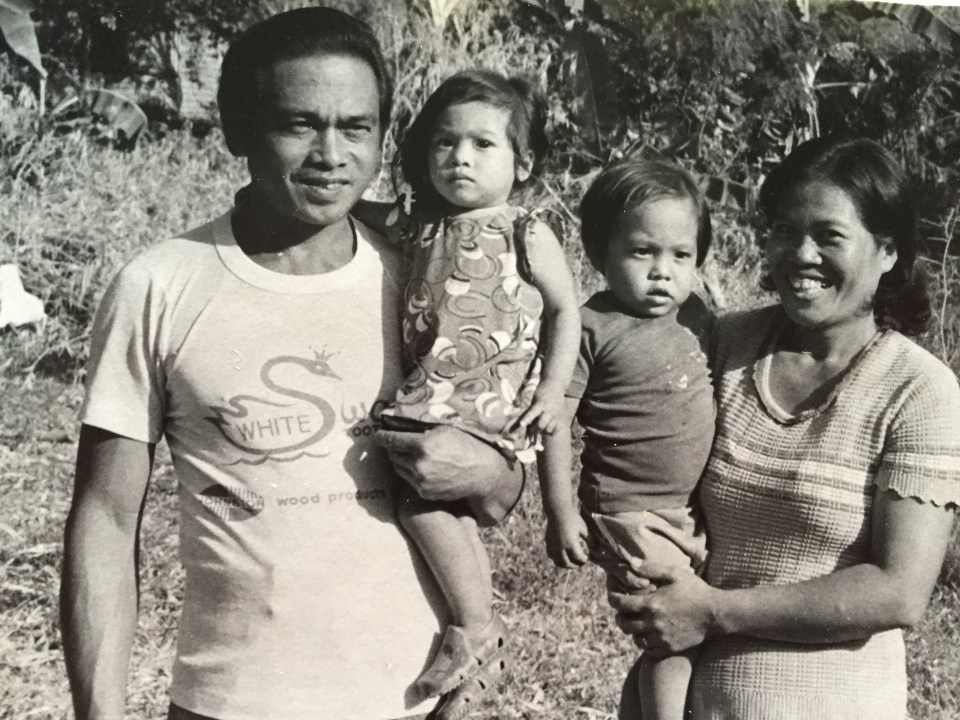
Celsa’s family
- We went to barrio Camangahan. There was good attendance. The people are relaxing with me and vica versa. During the class I sat comfortably by Manong Flor, an arm around my shoulder.
- Spent most of the day at Cubay fiesta, listening to singing and guitar music, relaxing, enjoying. I’m contented and have time to spare for people.
- I’ve had a sore throat and didn’t accomplish much, but I’m not bothered; things are going peacefully and pleasantly enough.
- I meditate in my own way when I walk to the barrios, take a six hour bus ride, swim in the ocean, do my hand laundry, or fetch water. My body much takes care of itself and my mind travels to new places. Most understandings come at such times.
- I stopped at Antique Doctor’s Hospital to see Inday. It’s good to have friends; to know someone is happy to see you and to share smiles.
- It’s easy to get lonely and miss the Cascade Mountains, my ten-speed bicycle, Baskin and Robbins ice cream, television, wearing sweaters, down sleeping bags, Christmas, bookstores, ferry boats across Puget Sound, friends singing, movies, records, my sister. But when I get a letter and read of western hassles, I’m happy to be right here. I say to myself, that could be me arguing or biting my lip. I could be depressed by bicentennial propaganda. Instead, I stretch out on the bamboo, fetch a couple of buckets of water, worry about nothing, and let my mind take me where it will.
there is time
when no time elapses
no choices made
nothing left undone
no alarm clock
needed impulse
directs activities
unrelated
following in succession
without break
no questions
Small Victories
The days pass quickly with a free feeling, getting exercise in the hills and busily working with only minor frustrations. All the little errands get vaguely easier because people know me now. I have a sense of being part of the life. I keep busy with a hundred errands for my work and feel satisfied to carry out many things in the dialect when I travel about the barrios alone. Some days the work brings me the opportunity to have a healthy walk and enjoy the scenery, like the 14 kilometer walk back from Bagtason, a mountain barrio. I’m much better off than many of the volunteers who are doing nothing work-related. I prefer to accomplish some work, not in terms of obligation to the great US government who is paying me, but in terms of the people here, because they’re so kind and generous. They literally would do anything for me. Giving away the best you have is really the way of life here. Maybe some of it’ll rub off on this one selfish Americana.
This month we held the fifth graduation for the Mother’s Classes of my Nutrition Edcation Project. In each barrio I spend about three weeks practically living in the barrio from sun-up to sun-down. I do house-to-house surveys , weigh the children, distribute invitations, set up an afternoon class series, get the visual aids prepared, remind guest lecturers, get diplomas ready, and more. We try to hold clinic in that barrio some morning concurrently and I make it a point to give a special, personalized invitation to malnourished or sick cases I have uncovered during the house-to-house surveying. I also prepare and distribute chlorine bottles to the mothers for water purification. We’re now involved in follow-up projects: planting vegetable and bean gardens in the same barrios. In Talisay I was very satisfied with the large number of enthusiastic mothers who met for our follow-up to the original Mothers’ Class program. We hope to use the nutritious foods in cooking classes, and feeding programs for the small children.
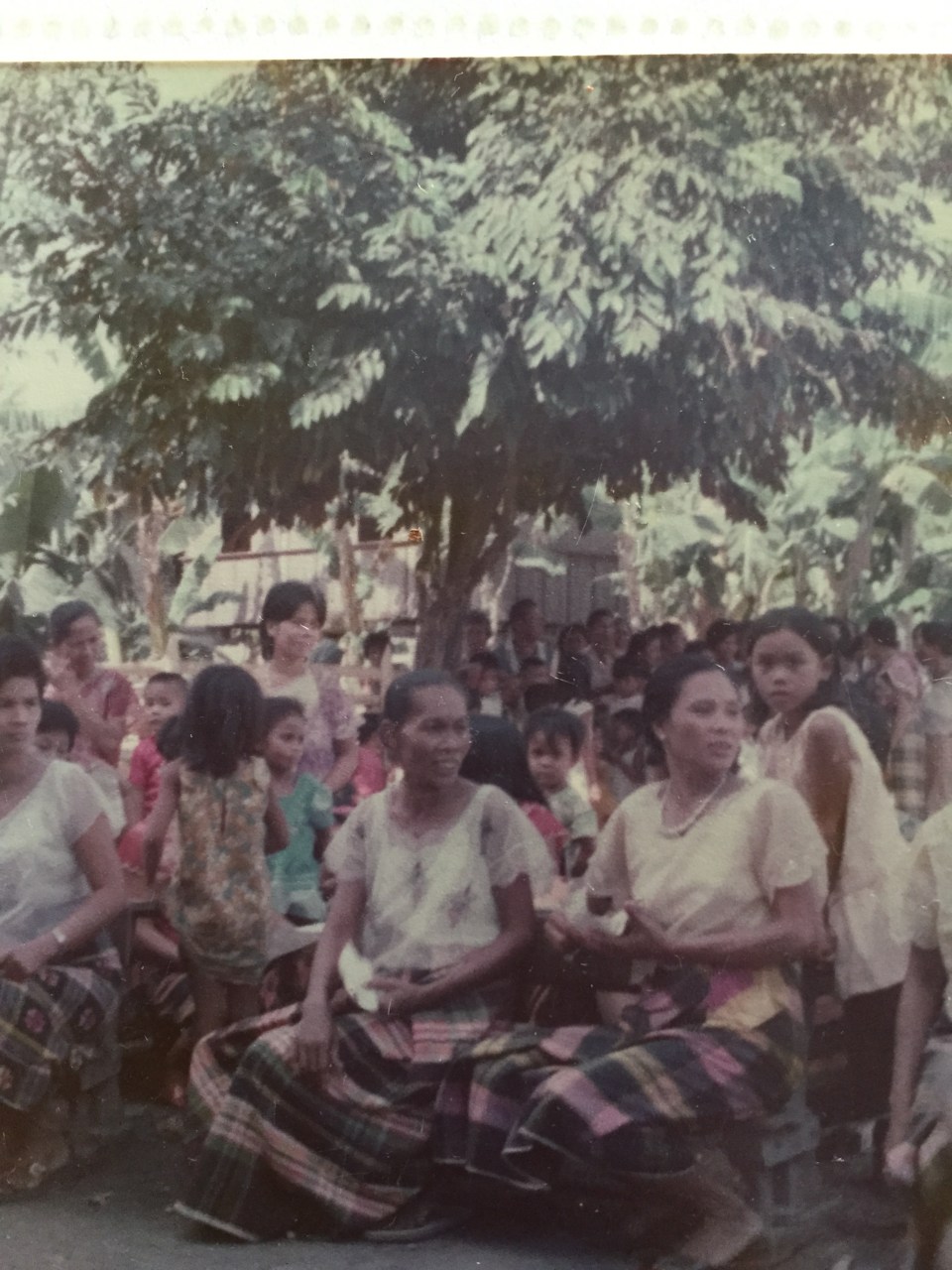
Mothers Class Graduation
The successes of work may be a bit unrealistic because everyone in town supports me and pampers me so much. ‘Sacrifice’ is a favorite expression here. Everything I do is considered a sacrifice, e.g., walking to the barrios, living in a nipa hut, riding public transportation, working in the barrios. It feels like no sacrifice at all. I enjoy the life and in reality, the successes are not mine. My role is mostly organizational. I am here to act as a catalyst in coordinating the efforts and enthusiasm of the different local agencies. The framework is here but many local agencies get caught up in paper-pushing and neglect the field work. I get them out in the field, actually the barrio. So in reality, the local people do the real work. My favorite part is the house-to-house surveying, especially talking with the barrio people who seldom leave the barrio, except maybe to go to market on Sunday. But even surveying gets tedious under the hot sun.
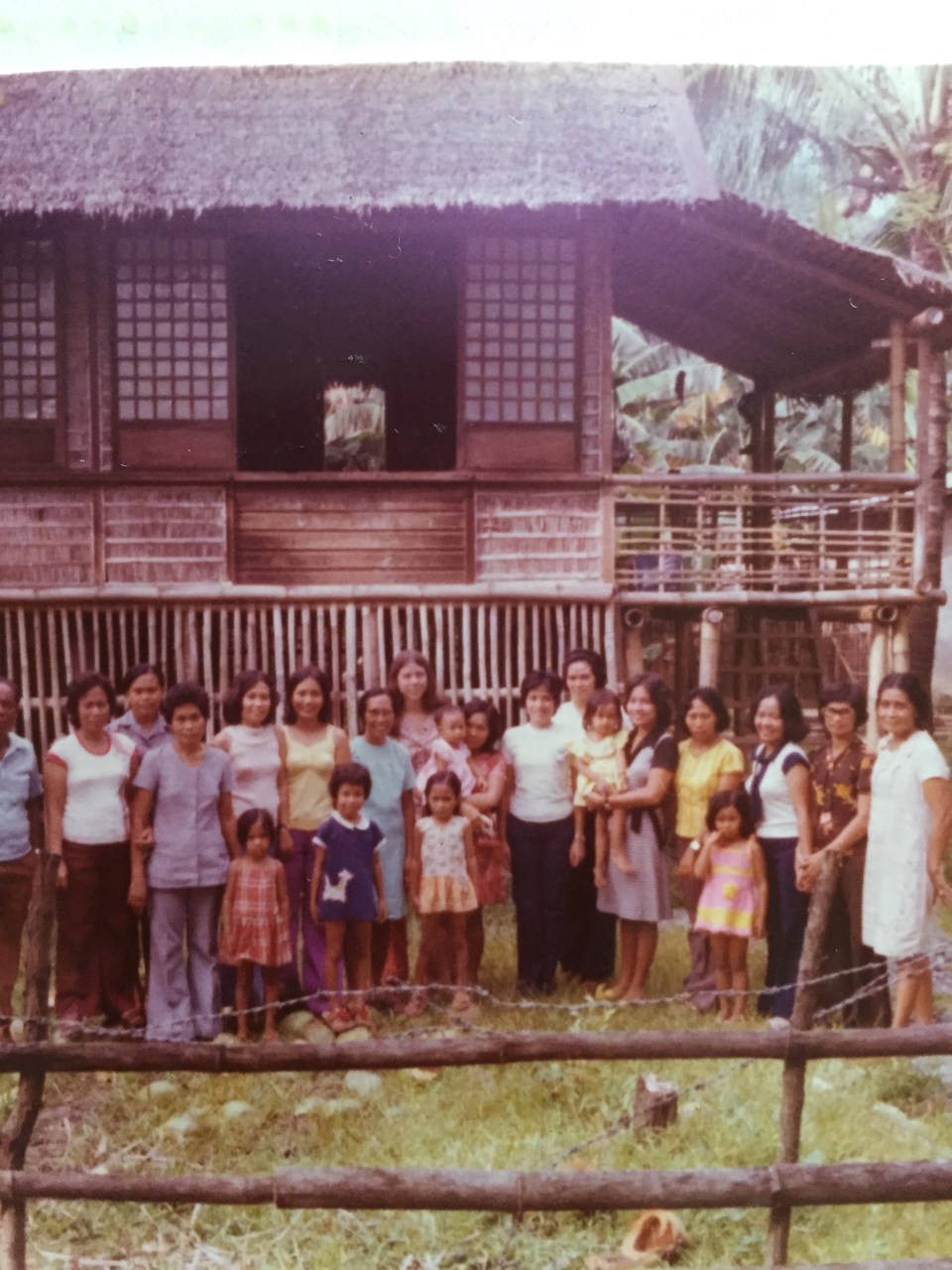
My colleagues from the health center
One day we held a meeting of the Municipal Nutrition Committee. Supposedly it existed before I got here, though it had never convened. I organized it and went to the town hall a little early for the 10 a.m. meeting. As it turns out, most of the attendees were already arriving, but for a different mayor’s meeting that was supposed to be held at 8 a.m. I sent for the rural health center colleagues and our meeting was held first, on “American time”, at 10 a.m., as scheduled. It was great. We made good plans and I felt a lot of community commitment. We’re planning a community “Health & Nutrution Fair” for the end of February—to involve the schools, local agencies, churches, etc. Rainy season will be over, but hot season will not yet have arrived. School will be almost out for the summer break. The weather should be perfect for an outdoor fair with games, programs, prizes, information booths, souvenir stands (crafts made by the vocational High School), etc.
Some days the work is more unexpected, for example, when I was running a lot of errands around town for my projects, Mr. Solis gave me a tour of Antique Vocational School (AVS) and I had some pastries there made by students. I’m really impressed with the school. There should be more such high school/vocational schools for students in the states. I was later asked to be guest speaker on their day devoted to “scientific-mindedness”. I have been chosen because the students feel that I am “the one and only scientific-minded person in Bugasong”. What did I do to deserve this? Perhaps that’s what I get for going to college. Anyway, I couldn’t turn down the kids; they’re third year students, equivalent to 9th graders in the U.S. (Middle and High school is only four years here—rather than six.) The weekend before my speech I was stuck overnight in San Jose. I got up at 3:30 a.m. to catch the first jeep heading back to Bugasong, but because of a three-day storm, there was no transportation at that hour. It was weird walking around alone in San Jose before daylight. The capital city, a small town really, was completely empty because of the rain. I did get back to Bugasong, changed, and ran to the Vocational School to be guest speaker. It actually went well. I enjoyed it.
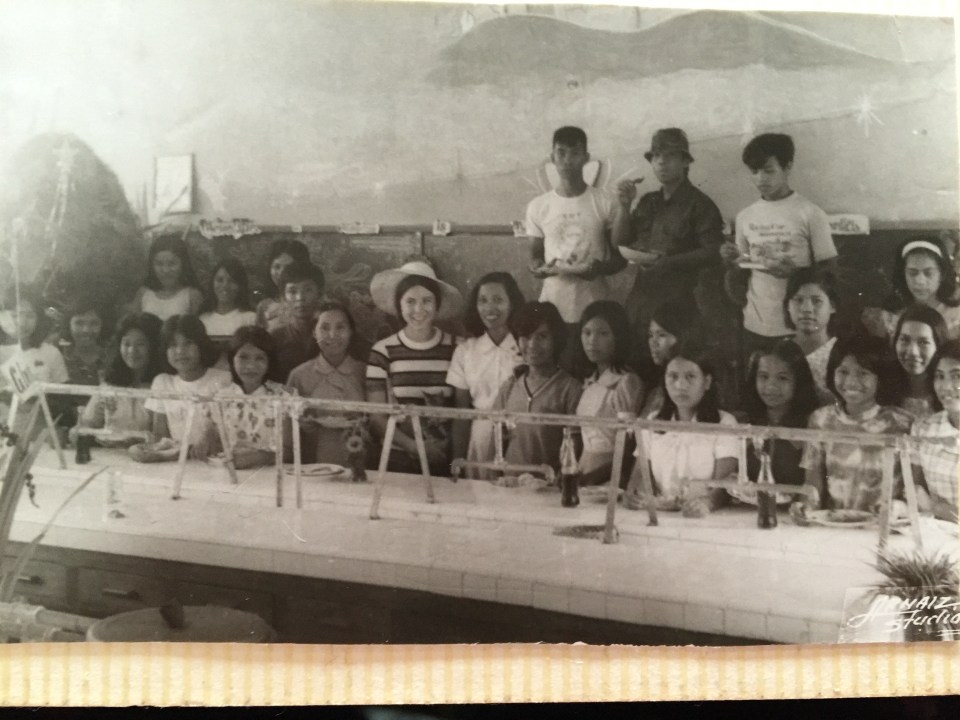
Visit to Antique Vocational School (AVS)
Autopsy of Violence
Went to San Jose just to get away I suppose, but it seems to have little to offer me now, so I returned to Bugasong by 3 p.m. for a birthday party of Florita. I unexpectedly ended up participating in the autopsy of a 20 year old boy who was stabbed (bolo-ed) to death the previous evening by an “enemy” as he walked home from a serenade with his “barkada” (friends). There were 16 wounds from the waist up, including head and one slicing the arm through both bones so that the hand just dangled by a piece of skin. No one was crying. The body had lain on the front step of the Center since 9 a.m. D.O.A. People were not shocked or even seemingly disturbed, merely curious. It was not seemingly an unusual occurrence. Less of a crowd gathered and their attention was held briefly than for Eking when he was chained as a “mad” boy at a court yard of the municipio. The victim looked like a war victim. I understand why fear is predominant here now if violence is so ordinary and possible. How could one person do such a thing to another?
No one was prepared to assist the doctor who came down from Luauan to conduct the autopsy. So I assisted, measuring the depth and number of wounds as someone recorded the results. It is the reaction, or lack of reaction, from the local people that stands out in my mind. The actual autopsy was like anatomy class—scientifically distracting. I found it easier to deal with than the stabbings of people who live and come in to our clinic in pain and scarred or deformed.
Here on stilts
among strange fruit
palms holding me
feeding the awkward creation
upright and lugging
pails of water
to wash those artificial
linked pretensions
where is reason
mutilated young body
with no arm held today
killed last night
with fisted palms
Some Things Still Surprise Me
Went then to Rivero’s house to see the boy baby that the Doctor and Doctora bought today for 100 pesos. The baby’s mother had lost the older child to malnutrition and was unable to care for the baby. The boys name is Ricky.
Here he is Ricky a couple of years later with lolo tatay, Manual Rivero Senior, playing the banduria


They really celebrate All Saints Day (Nov 1) and All Souls Day (Nov 2). They take flowers and food to the cemetery for all the “Souls” (I wonder if the dogs eat it). Then they have a mass at the cemetery. They eat leftover special foods or take it to neighbors like me.
I found a 1934 book on Seattle rotting in the Bugason Public Library.
A “Child of God” (not quite sure of the origin of that religion) could see it in my eyes that I will one day be one of them.
 toughestjobyoulleverlove