The ramblings of my journals, audiotapes, and letters from June 1975 were prolific and hard to wrangle. While many calendar jottings were short and documented everyday life, there were also long reflective pieces, as well as disorganized mutterings into the tape recorder. It is clear however, that in this sixth month in town, I had settled in. Life in Bugasong was becoming ordinary for me, at times mundane. I had fully committed and did not think I might leave early.
A lot of strange things happen here, the sort of things the first 22 years didn’t prepare me for, but I’m convinced that I should live out this thing because I feel that the experience is right for me.
Here are snippets from my journals that reflect the life of a volunteer who has settled in to the work, the community, and the home life:
- the day begins with sweeping up and preparing for breakfast at 7 am, a merienda (snack) at 9:30 and lunch at 11:30 or 12, followed by siesta. In the afternoon we have merienda again at 2:30 and 5. Dinner is at 7
- played with the babies, Peachie and Cherrie
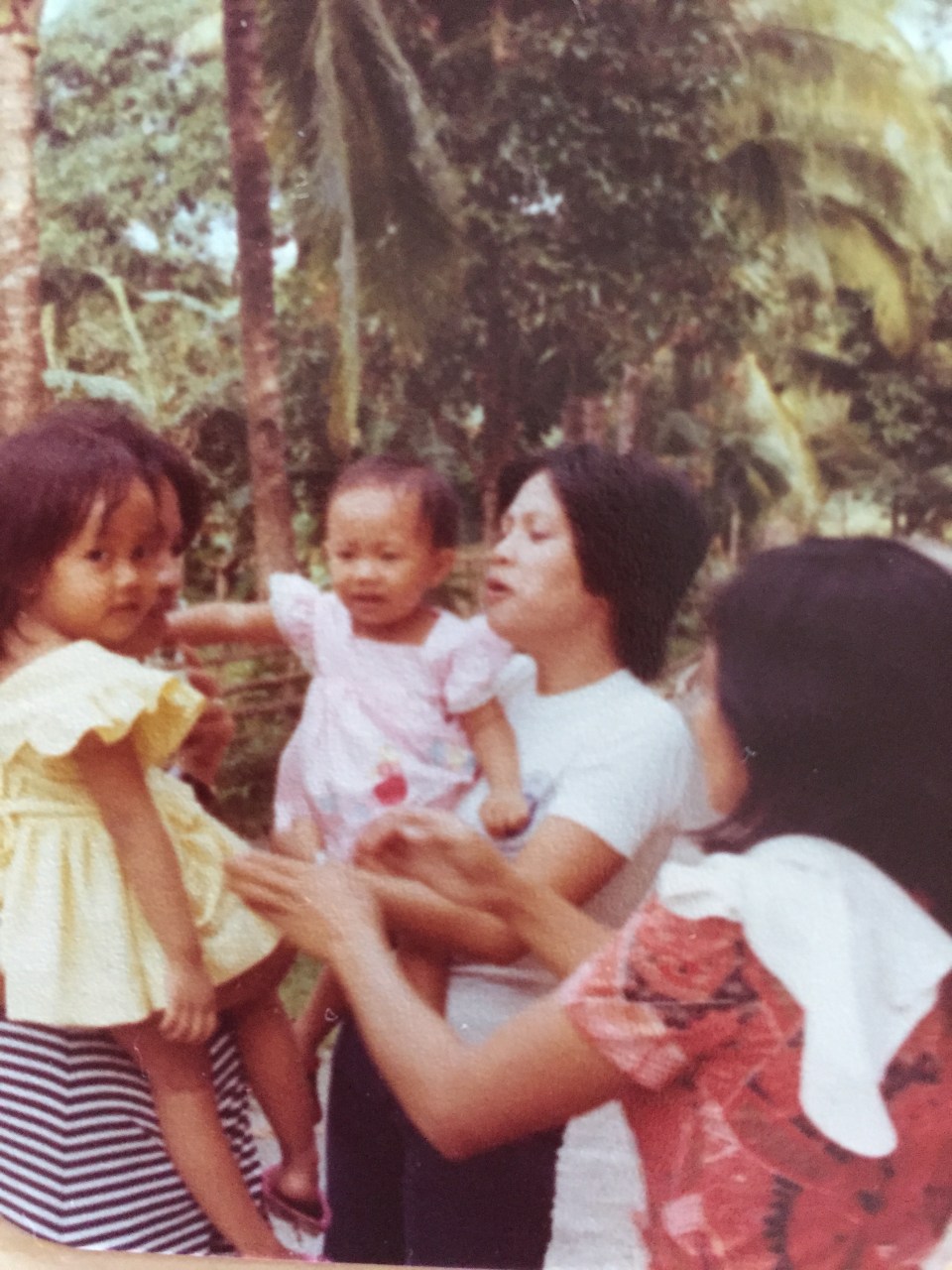
Peachie and Cherrie Rivero
- happily returned in time for sunset, talks, burning leaves, dinner, a game of scrabble
- a free day with no projects in process, not even a book. Spent time on yoga, a long beach walk in a heavy rainstorm, a conversation about martial law and freedom, a birthday dinner party. I am really here
- was interrupted for fitting of a blouse made out of hand woven, embroidered fabric that I bought in Iloilo. The seamstress charged me 4 pesos (about 60¢). She’s poor and works so hard. I wanted to pay more. She finally accepted 10 pesos
- went to Belison for meeting with Dave and Tom. They were happy from their travels. Enjoyed their company, a few beers, popcorn, relaxation and laughter
- Friday melted away and became Saturday. Days keep coming, always waking in the same bed with time enough to get up slowly and think about my dreams and where I am
- had 4 vacation days off because Thursday was Philippine Independence Day (martial law style). There was a parade, speeches, and a dance. The parade was fun because of kids
- walked home in the dark luscious rain. Let us give thanks for the ever cleansing rains falling upon our ironed shirts.
- early morning I went to market. People are getting used to me, or vica versa. I can enjoy myself in public
- had fun running around with some grade school kids at the beach
- the house has quieted down to soft music and babies being rocked
- met other volunteers for the weekend. Had pizza, a banana split, and guzzled milk on a bench in a park. The time away was fun without being intensified as an escape
- sometimes feel constrained by a lack of exuberance, presence of inhibitions, or extreme moodiness of other volunteers. It’s all part of friendship though
- had severe cramps with extreme diarrhea but remained serene and managed to sleep well and deeply. I’m getting used to ups and downs
- had snacks, paced around the clinic, made small talk, drank coca cola, played with kids, took a siesta, lived like everyone else here
Work:
- helped doctora stitch up a baby’s head
- arranged and labeled medicine cabinet, swept, threw out old medicines
- tabulated surveys of children’s weight to determine malnutrition
- went with a nurse to immunize 1st graders
- was awake early so I went to the Health Center. Cleaned and reorganized. Worked hard. I think the center is much better now
- spent the morning giving BCG injections for tuberculosis
- worked with the health unit on Operation Timbang Semininar preparations
- had plans for a house-to-house survey, but it was raining early in the morning. I hope it doesn’t rain all day every day
- prepared my speech and visual aids for tomorrow’s seminar.
- rose early to practice a lecture for 200 people. All went well, but the loudspeaker and crowds gave me a headache
- began surveying barrio Jinalinan, for Mother’s Class next week
- will miss Linda when she finishes underboard nurse duty
- trucked off to San Jose for another meeting with the governor
- got 44 parents enrolled in a barrio health & nutrition class
- starting a water purification project to stop typhoid and cholera, but not amoeba unfortunately
- am busy enough
Rainy Season
What could be more ordinary than writing about the weather…
There are two seasons here: dust and mud, also known as dry and wet. In the rainy season, my sandals sink into mud and as I pull my foot up, the suction releases the sandal with a force that catapults mud up my back. In dry season, dust cakes to my sweat to create a body armor of clay. In either case, I’m covered with dirt. The local solution is to travel with a towel over your head to keep off rain or dust. When the sun sets, everything is okay again, except for the myriad mosquitos feeding ravenously on my blood.
Dry season is over, it’s rainy season now. I just walked over to the glassless window where I stand and listen to the thunderous sound of rain on a nipa house. Unlike Seattle where rain droops out of the sky in a mist, here the whole cloud falls down in little pieces. I’ve stayed in my room practically all day reading. One should never pass whole days without wandering under the sky. But it always rains in the afternoons and thunders, just when I want to get out. Dear God, don’t ever let me become an indoor person. After lunch I fell asleep to the rhythmic sounds of the rain and had a wonderful dream about brownies with vanilla ice cream. Oh what I wouldn’t do for a hot fudge brownie sundae, and a glass of cold milk. Oh, but mangos. You should taste mangos. The Papayas are just okay, but mangos are heaven. And it doesn’t matter if there’s no chocolate cake, because I just heard a little knock on the door frame. It’s one of our helpers. I can see her little feet sticking out below the curtain. When I go to the door (the hanging curtain really) and ask what she wants, she offers delicious fried bananas with sugar.
During rainy season I should forget my cherished sunset swims and dusky beach walks becasue every afternoon it pours. I usually put aside all plans for a walk, but yesterday I decided to go anyway. Umbrella under arm, I trekked off to the ocean and wandered down the beach to where the river enters. Just then the sky opened up and began to rain—not cats and dogs, but full grown ocelots and St. Bernards. In the best girl scout fashion, I was prepared. I raised my green umbrella, purchased for 20 pesos. It protected me well for two minutes. Then streams of water began to penetrate my green portable shelter. An hour later, through nonstop thunder storms, I arrived home wet and singing off key.
Rain
Moist damp luscious dark
crawling up my calves
dripping from eyebrows into blue
gleaming faces on bare wet shoulders
tingling with life energy
The inside of my shoes and my suitcase that doubles as a bureau, layers of mold are growing, fed by the humidity. I keep washing the fabric in my suitcase with water and bleach. It helps but is tedious.
June Autumn
Burning leaves smell of October
even now in June,
in the tropics
pleasures dissociate
tap one sense or other
to call up
memory treasures
Town Life
The health clinic where I work is not pristine. The roof leaks in dozens of spots. Scattered pans and other vessels catch the leaking sludge. The dust is measurably thick and the medicine outdated. This week I filled a garbage can with long-expired medicine. But the floor of the waiting room is spotless. The women take a half coconut shell, upside-down (empty of course) and stand atop with one bare foot. The other foot is on the floor. They skate around gracefully on the coconut shell to polish the floor. It does a nice job shining bamboo floors, and equally this painted cement in the rural health center.
Cement, like plastic, seems to be a bit of a status symbol. I prefer bamboo and nipa structures aesthetically and for practicality. They are cooler in the tropical heat. They feel calming and natural. I like the romantic notion of living off the land. In some of our barrios, women weave fabric for their patadyong (tubular skirt). Patadyongs double as hammocks for babies or backpacks for carrying goods. The houses are the same as they’ve been for thousands of years. Nothing’s essentially changed except the plastic mobiles hanging inside the house.
Our town faces the ocean to the west, with no mainland between us and Asia. It’s a long way. We have magnificent ocean sunsets. In every other direction, mountains rise up from rice paddies. People trek by with hollow bamboo poles to fill at the water pump and carry back to their nipa houses. Tuba gatherers climb the coconut trees at sunset to gather the sweet fermented drink. At dusk fishermen bring in their dug out boats and can be seen pulling in nets. When I walk back to the center of town from this beautiful sunset scene, the nipa houses are crowded together much like a city dwelling would be. There’s more space where the rich landowners own fields of rice paddies or sugar cane; or where the terrain is too rough up in the mountains.
This crowding carries into the culture. People never walk alone. If I walk down the street to the sari sari store (a little store that has everything in it—umbrellas to batteries, food and more), people ask me “where is your companion”. It isn’t only women; the men walk around with companions, put their arms around each other, hold hands, lock elbows. It’s hard to put my finger on why it’s awkward for me. Perhaps being close is a natural part of culture in a small environment. The islands are small. This country is 53rd smallest, or largest—53rd in size, but it’s 14th in population and going up. Families have 10, 11 people.
The people will tell me I’m growing fat. “Matambok ikow. Guapa. Guapa.” Which means, “Oh you’re growing beautiful because you’re growing fat.” I try to say that Americans think skinny is beautiful. But here, if you’re not a little overweight, it means your family can’t afford to feed you right. My family wants me to grow fat so that when I go back to the states, my father will know that they fed me right.
School started on Monday, June 2nd. According to Manang Nene, an elementary teacher and the older sister in my family, not many of the students showed up for the first three days, so they didn’t really start classes until Thursday. Friday was only a half day. During the second week of school, the students attended for three days because Thursday was Independence Day holiday and President Marcos declared a sandwich day holiday for Friday. A sandwich day is a day stuck between a holiday and a weekend day, and so becomes a special holiday. During the third week of the school year, the teachers will have a three day math conference which about 10% of the teachers will attend. Many teachers attend about one half day total, but others don’t go at all. So students are out on Monday, Tuesday, and Wednesday. At town fiesta, all children are excused from classes for a week so that they can help their families prepare.
The post office is located on the town plaza, below town hall and kitty corner to the health center. One morning a package for me was delivered at the clinic. The nurses and midwives were anxious to see what I’d received from the states, so I showed them. The box contained bras that had been sent by my mother to replace ones that were stolen from the clothesline at our training site in Cebu. In Filipino stores, they weren’t available in my size, so I had some sent from the states. My colleagues at the health center had never seen American bras. They wanted to know what I put inside them. It took a while for me to understand the question, because of course one puts boobs inside them. But the question was really, what else I stuffed them with to fill out the cup. I said I didn’t stuff them with anything except me. They couldn’t believe it. They kept asking me “What do you put inside?”, and I answered repeatedly, “me”. They finally had to look to see for themselves. So I pulled open the top of my shirt and let the women look down. They reached in and felt inside the top of the bra and realized it was really all me in there. I think they were a bit astounded, if not appalled.
Independence Day
Independence Day seems like an unusual celebration under martial law. Bugasong celebrated with parades, speeches, a dance, and a contest for “Miss Independence”. They wanted me to compete for Miss Independence as “Miss Pujo” and ride on an Independence Day float, competing with Miss Ilaures, and Miss Ilaoud. There are three barrios that make up the center of town. I live in Pojo. Money is raised by men paying money to dance with the women. People can also contribute to the float. A rich woman in town would sponsor me and double any money raised. All proceeds go to a good cause, the rural health center where I work. At the end of the night, the person who brings in the most money becomes Miss Independence. As a feminist, and as a representative of the nation from which the Philippines gained its independence, I declined. My colleagues at the health center couldn’t understand why I didn’t want to do it. They begged me repeatedly (up 15 or 20 times a day). I held strong in my refusal. They were insistent. I was insistent. I missed a once in a lifetime opportunity to be displayed in a pink sequined formal on a decorated side car to a motorcycle decorated with crocheted table cloths, artificial flowers, and cellophane Philippine flags. At the dance I refused to dance slow dances. Everyone thought it must be due to a mysterious fiancee back in the states. Fortunately only about 20% of the dances were fast music, so I didn’t have to dance constantly. I mostly danced with young college students home on vacation, no old drunk men. I’ve gotten fairly used to being stared at, but am not fond of dancing close with drunk men. It was fun hanging out with my colleagues—the nurses, midwives, and family planning motivators. They’re all women and married, mostly between 28 and 35 years old. We sat close together and played with each others’ hair and chatted. It was affectionate. Seemed to me like a sisterhood. It was relaxing and I’m glad to be a part.
Universal Patriotism
(Independence Day I)
We kill each other within limits
law and custom delay and deny
our guilt transposed
in key for organ hymns
unless John Philip Sousa
claims group innocence
selves-righteousness
Francis Scott Key
or Adolf Hitlerism
parades picnics
Sunday after services
week-day funerals’
home-made picnic pie
tasting scrumptious
of February cherries
honoring all repentant boys
freed of guilt sufficiently
to stand with bleeding men
crying to Father George
their Saturday confessions
of loving women and skirts
that might be dancing
but turn their pirouettes
to black holy innocent voices
praying for red death
and blue return
worship of green and silver
which outlive even wounds
which limp five decades hence
parading for mothers
children eating ice cream cones
forgetting to share their flags
they wave to our caresses.
Carbon Copy in Red, White, and Blue
(Independence Day II)
After the parade speeches run over
little children sunshine withering
away to ice cream escapes
for bored parents laughing
in their favorite clothes
double-scoops rest atop
inverted triangles of indecision
indicting non-circumscribed wants
from torn minds schooled in true and false
twenty minus two still above average
surprised by chocolate cake and
one half hour of televised lies
away from innocence of quilts
and worlds that could be focused
behind closed eyes sucking thumbs
known so well the pleasures undirected
unrestrained residing juxtaposed to minds
untorn
On the Legacy of War
Got into a conversation about the lack of civil liberties under martial law. I was told that Filipinos are submissive because they are afraid of another war that could devastate them and divide their families. The memory of World Was II is strong.
Self-reflection
For some,
perhaps most,
the years which lead
to liking oneself
are long.
I spend a lot of time contemplating without concurrent intellectual conversations that I might be having stateside. I read a lot and dwell on the ideas, however insightful or dull they may be. This month I also focussed on meditation and yoga. At times my dreams joined in.
I am seeing the sad culmination of a time of looseness, selfness, Sansara and the resultant degenerating spirit. I have learned many things about myself from my youth in western society—things which need to be outgrown. Now is a good time to discard habits that bind me and retain simple ways necessary to be at peace in the world. I need to engage in an honest evaluation of what I have learned about myself, and the self-discipline to avoid the magnification of errors I have made. I know this will not all be accomplished here and now, but perhaps one more error can be removed and one more joy can be known. To accomplish this I see the necessity of focus, reflection, and self-discipline as a means of cleansing my body and mind. It sounds abstract, like all the things I learn about myself as they are coming onto focus.
If I could only learn to live and love without judging.
Good to feel accepting eyes
speaking from over there
to me, unaccusing
joining me at depths within
taking down defenses
still winning no offensive
To accomplish my inward-facing goals, I set a schedule that included diet, exercise, yoga, meditation, sleep, writing, work, language study, appreciating nature, reading and music. I articulated goals: to be less aware of my self and more aware of others, to learn to listen and hear, to become less vain and more natural, to be less worldly and materialistic. Yoga has been an immeasurable help.
Meditating I saw
the cluttered file cabinets
of my mind
envisioned a bonfire
for the bullshit
keeping me warm
on a rainy mountain side.
I’ve been recently plagued by insomnia. Last night I read and did an hour of yoga before bed. It proves to be the most serene part of the day, and I sleep short but well.
When sleep fell, my dreams chased me, frightened, evaded meaning, but hung on when I awoke.
Yoga and the meditations seem to be releasing that energy promised. Just now, reflecting, I realize how early I arose and with vitality.
Early Meditations
In the recesses of my vast mind
interweavings of six senses
drop from assorted files
unalphabetically ordered
seeping to the foreground
theater of my present knowing
scenes misplaced
but no less relevant
to the experience
of make-up I will wear
of the final act
which is conception
and decomposition
simultaneous
Finished reading The Glass Bead Game, by Hermann Hesse. In the book a man from an elite intellectual society is sent on a teaching assignment to a Benedictine Monastery. His views overwhelmed me as being like a Peace Corps Volunteer (PCV) in the Philippines:
“the manners, style of life, and general tone of intercourse among the monks was couched in a tempo hitherto unkown to him. There was a kind of venerable slowness, a leisurely and benign patience in which all these Fathers seemed to share, including those with temperments seemed rather more active. It was the spirit of their Order, the millennial pace of an age-old, privileged community whose orderly existence had survived hundreds of vicissitudes. They all shared it, as every bee shares the fate of its hive, sleeps its sleep, suffers its suffering, trembles with its trembling. This Benedictine temper seemed at first glance less intellectual, less supple and acute, less active than the style of life in Castalia (the intellectual society’s community), but on the other hand calmer, less malleable, older, more resistant to tribulations. The Spirit and mentality of this place had long ago achieved a harmony with nature.”
When this character writes back to his society about his trouble in adjusting, the following is the reply he received. Other PCV’s agreed with me that it sounds like a memo we might receive from our director:
“Don’t worry about taking all the time you need for your study of the life there. Profit by your days, learn, try to make yourself well liked and useful, insofar as you find your hosts receptive, but do not obtrude yourself, and never seem more impatient, never seem to be under more pressure than they. Even if they should go on treating you for an entire year as if each day were your first as a guest in their house, enter calmly into the spirit of it and behave as if two or even ten years more do not matter to you. Take it as a test in the practice of patience, meditate carefully. If time hangs heavy on your hands, set aside a few hours everyday, no more than four, for some regular work, study, or copying of manuscripts say. But avoid giving the impression of diligence; be at the disposal of everyone who wishes to chat with you.”
The response above is almost a summary of my life here.
I also read Anthony Quinn’s autobiography called Original Sin and have been thinking about the line: “We have all been traitors for one simple reason. We have all failed to love.” I think that line is from a movie called The Magus about a man who falls in love but refuses it. He goes for a secure unattached life. He is later put on trial, not specifically for his girl friend’s suicide but for the thing of which he pleads guilty, “having failed to love”. It makes me wonder if I have ever really loved unconditionally. Or do I always require things or expect things?
Fairy Tale Love
Rhythmically waves pound soothe
I remember that other rhythm
my ear was pressed tightly
to the chest of my always fairy-tale lover
it’s still fairy tales when I sleep
whether with a lover or alone
Evolving thoughts on solitude:
“Solitude is the Art of Being Alone Without Being Lonely”, Anonymous
It’s difficult for me to read in a noisy environment with no solid walls. I’d like to dance on a lawn, release myself, or meditate. I’m suppressed by wall-to-wall people and noise. But the people are happy in their noise and off key singing—and I enjoy that. Still, I feel sometimes misplaced—as if I should be in a place of solitude. And yet it’s so right to sit here now, watching the baby’s eyelids droop, and feeling the vibrations of their rocking through the bamboo floor, listening to soft music.
Touch of Mind
Ice fills the small of my back uncold
dark coals sizzle at my thighs unhot
voices shout at my neck unloud
spider webs form between my eyelids unseen
realities travel downward undigested
carried brainward in corpuscles
transmitting fantasies sensed
I try to remember the revelation that overwhelmed me just time ago, but am at a loss to know any of it. It’s something that sprung up from aloneness here in a strange culture, or should I say loneliness. My mind was meandering through those border recesses of idea, where thought just meets emotion in the struggle for dominance. The wanderings of my mind now attached to this ink on paper begins to bring it all closer to me. It had to do with expectations of the moment; that in my loving I have always clutched to a belief that momentary joy would some day be neatly packaged, constructing a beautiful memory. (“preserve your memories; they’re all that’s left you.”) Never could I allow friendship to grow into love, for if it failed, its memory would be bitter. So love was protected and moments spent gently, swept off briskly, undamaged, then placed under glass. I saw reality not in the present, but in the form experiences take in retrospect. But if pain occurs, I now feel prepared to deal with the wanderings of my mind in its acute retrospective nature. I’ve passed through endless treks into the borders of my understanding during these past months of loneliness. My aloneness here has brought me to certain realizations—that alone I can cope with the memories that were once able to consume me. I wonder how long it may take to dismantle my well-developed defenses.
I also seemed to still think a lot about home and friends left behind, as evidenced by writing down a string of quotes from some of the taped music I brought with me:
No Good News
No Bad News
There’s No News at All
‘Cept the New York Times
Why don’t you write me I’m
out in the jungle I’m hungry
to hear you
Everybody
must get
stoned
Can’t remember when I’ve
ever been so lonely I’ve
forgot what it’s like to
be home—
can’t remember
what it’s like to be home
Homeward Bound
I wish I was,
Homeward Bound.
Home
where my thoughts escape me
So far away.
Doesn’t anybody
stay in one place anymore?
It would be so fine to see your face
at my door.
And it doesn’t help to know
that you’re just
time away.
Poems for My Sister, My Oldest and Best Friend
Catch a Falling Star
“Where ya goin’, Cherry?”
“Crazy, wanna come?”
oh, but I do
your face told me the necessary ritual
of leaving me behind
would never change your evening Cuckoo Song
or singing Catch a Falling Star while doing dishes
—our sisters’ chore that somehow boys escaped
and put it in your pocket
we accepted and made a thousand games
i followed your expertise at contriving
save it for a rainy day
games to make the growing easier
never let it fade away
rules of the land and how to live
with big people—parents and such
we have a pocket full of starlight and secrets
your wisdom, my innocence
save it for a rainy day
I grew lanky when you wore stockings
your friends couldn’t smile
the worst sin—you had no time
for dishes, for sister chores
I left salt tears in ivory soap suds
had I grown one inch too tall
would I enter uncaringness, big peoplehood
what use is starlight in pockets
when there’s no one to share
but you came back at 2 A.M. after work
we ate brownies and ice cream
alone in your green room with secrets
we emptied pockets and filled them
I helped you pack for college
made brownies or cookies every day
to have time alone with you
so beautiful you were reaching back your hand
to want to be with me who later went on
to other outstretched hands
trusting unknown people
crossing oceans, climbing mountains
always carrying my pocketful
reaching out to you sometimes
sharing separate experiences
or childhood red-bed memories
and poems that we save for rainy days
Airmail
just because you’re there and i’m not
i’m sending airmail thoughts when i think them
colorful stamps when I have them
poems when i write them
jokes and sarcasm thrown in with my moods
carried by planes perhaps from Boeing
where dad earned our college tuition
for baccalaureate words we share
across oceans and over mountains
some people use all their words by forty
spend all combinations by sixty
not us we’ll have uncollege things to say
if we ever sit and brush each others’ gray hair
 toughestjobyoulleverlove